How can one teach Go effectively?

Rereading the article now, I recall looking at it before when you posted it previously.

One thing relevant for

might be

What most people often forget is that go is simply a game to most people. Like chess, checkers, or video games, it is just one way to pass the time and enjoy themselves. It is not something that they obsess over and try to improve at the way most of us do. As a result, the mindset needs to be completely different for these people.

Teaching go is reserved for trying to help a player gain another stone in rank. This is not what you are doing. You are simply trying to help someone learn the rules of go and be able to play a game on their own. It doesn’t matter if their moves are great, or whether or not they make mistakes, they simply need to be able to play and you will have accomplished your goal.

Though I think it can be extended also from beginners to other players that are just happy to play and don’t necessarily need to improve to enjoy it.

It goes on to say

As a result, your goal is not to “teach” go; but to instead market and sell it to anyone willing to give you their time and attention. You are not a teacher. You are a go enthusiast who wants to share with everyone why go is awesome and why they should play it. And the way you are going to do that is not by teaching them the game, but by introducing the rules to them in a fun and easy way.

So maybe I’ve absorbed more of the article than I thought XD

I think there are some good points about teaching new players in there, not trying to win, leaving weaknesses etc. When I play with newer players and they’re not sure where to play and they’re worried if I play move X, which doesn’t work for me, they’ll be in trouble, I just play it anyway and let them capture it etc. Even with doing things like that it can still be a close game. A lot of players also don’t want handicap, and it’s not clear I would say to people how big skill gaps can be anyway in a game they’re new to.

Even if a group only has one eye at the end of the game (9x9), I just let it live and count the points.

This one I do feel a bit more like objecting too. I don’t think we should encourage people to score games incorrectly :slight_smile: It’s different if it’s surrounding area and there’s a weakness, like some four or six spaces in the corner. I might mention it that there’s a weakness depending on the player, or one can just leave it alone and count it as territory like the weakness wasn’t there.

It’s different when a group is just dead with one eye. Any go app you play on will probably mark it dead, when you play online with people or bots, it’ll mark it dead, so it kind of just serves to add to the confusion not to learn to score properly :slight_smile:

3 Likes

Go is part of math (game theory), is there a reason why insights on [teaching math] can’t be carried over to [teaching go]?

5 Likes

@Groin, thanks for your insights. I assume this comes from a decent amount of teaching experience? Did you talk with other teachers to find out, what works well? Do you teach individuals or groups of people?

How do you decide on a topic or concept you want to focus on? What to teach is probably an important question. Categorizing what areas there are to teach is probably valuable too.

I think it’s good to keep that in mind. There’s probably just a very limited amount of empiric findings specific to teaching go, but we also know more than nothing (go has been taught for centuries and maybe even more), we can listen to experienced teachers and analyze learning material like books.

That sounds very interesting. National federations and other institutions probably care about having good teachers. How does that diploma work? Can we read about it somewhere?

True and I think investigating that question can lead to valuable insights for teaching too.

Sure, and maybe we can focus (but not necessarily entirely) on how to teach kyu players, as most players on OGS are kyu players themselves, so they won’t be able to teach dan players.

I don’t think being good at game theory implies being good at go, right? And game theory is maybe only taught at high level education?
There are surely some concepts of teaching math that can be applied to teaching go, but I doubt that it is as straightforward as you seem to imply. For example I wouldn’t know how to apply the CPA approach (see below) to teaching go.


Mathematics education is an entire scientific field, what are you interested in? Theoretical principles of teaching or empiric findings?

My knowledge base so far is sadly mainly influenced by German literature and for many concepts (that to me seem well established there) I don’t know well established English counterparts. So I can just give a few examples and they are far from being the best:

In 1977, Harold M. Edwards published his book Fermat’s Last Theorem – A genetic
introduction to algebraic number theory. He defines the genetic method as the explanation or
the assessment of an object or an incident with regards to its origin and development, […]

Mosvold, Reidar. “Genesis principles in mathematics education.” (2002).
https://openarchive.usn.no/usn-xmlui/bitstream/handle/11250/2439974/Rapp-2002-09.pdf?sequence=1

Applying this method, one reasonable approach to teach beginners is by using stone scoring. AFAIK it’s the original way to play the game and it lets players discover that two eyes are necessary for life naturally by just finishing a game.

Another method is using multiple representations, or more specific the concrete-pictorial-abstract approach (or CPA approach):
image
Source: Arbeitsblatt - Einführung Gleichungen - Mathematik - Gleichungen - mnweg.org

If each box contains the same number of matches and both sides of the equation have the same amount of matches, how many matches does one box contain?
To answer this question the concrete way, a student can start with empty boxes and add one match to each box, then check the amount on the left and the right side and repeat this until the amounts are equal. That can be tedious, just like solving equations on paper by trying all kinds of values for a variable until one finds a solution can be tedious.
Faster (but keeping the concrete representation) is to remove two matches from both sides and one box from both sides, so that only boxes are on the left side and only matches are on the right side. In our case, we now have only one box on the left side and ten matches on the right side, which means we’re done. One box has to contain ten matches.

A pictorial representation of this could consist of pictures of the boxes and matches after each operation is applied, here students have to internalize or imagine how matches and boxes are moved to get from one state to the other.

The abstract representation of this equation and how to solve it is just:

2x + 2 = x + 12    | -2
2x = x + 10    | -x
x = 10

The teaching method tells us to switch between these modes of representation multiple times until the students don’t need the concrete and pictorial representations anymore. If students then encounter problems like 2x = 0, they can remember the boxes and the problem becomes really easy. They can just imagine they have two boxes on one side and zero matches on the other side and will know right away each box has to contain zero matches.

I don’t know if there’s research on this specific 2x = 0 question, but there are empiric findings that the CPA approach can make teaching math more effective:

During the post-test and retention test, the performance of students in non- CPA group is on average level and students in CPA group are on above average level.

Salingay, N., and D. Tan. “Concrete-pictorial-abstract approach on students’ attitude and performance in mathematics.” International Journal of Scientific & Technology Research 7.5 (2018): 90-111.
https://www.academia.edu/37116083/

4 Likes

My second post in this thread is a wiki, so anyone can edit it and add relevant information. For now I’ll just add a list of the resources that were linked here so far.

3 Likes

For me, even though the metaphor is a stretch - I find it useful to think of it as similar to the way martial arts is taught. There’s a good reason they share a kyu / dan ranking system.

When white-belt beginners start, they are given basic ingredients, which they have to practice in an experiential way. Over time, as they rank up - not only do they learn a broader range of skills, but they also discover the difference between tactics and strategy - winning a battle, but losing a war, etc.

So, within the Go context, I don’t find it useful to start with tsumego or 9x9 because - those are both great practice for very particular, narrow things, but they won’t help you with that feeling of being completely lost or overwhelmed in your first 6 months worth of 19x19 games.

Rather, I prefer to start with basics like

  • Sente and Gote
  • Settling your stones
  • Playing a Balanced Opening
  • Learning the Stages of the Game
  • Rudimentary joseki and fuseki
  • Basics of Shape
  • Figuring out the different strategies of Go that can be applied at different skill levels, etc

my 2 cents

2 Likes

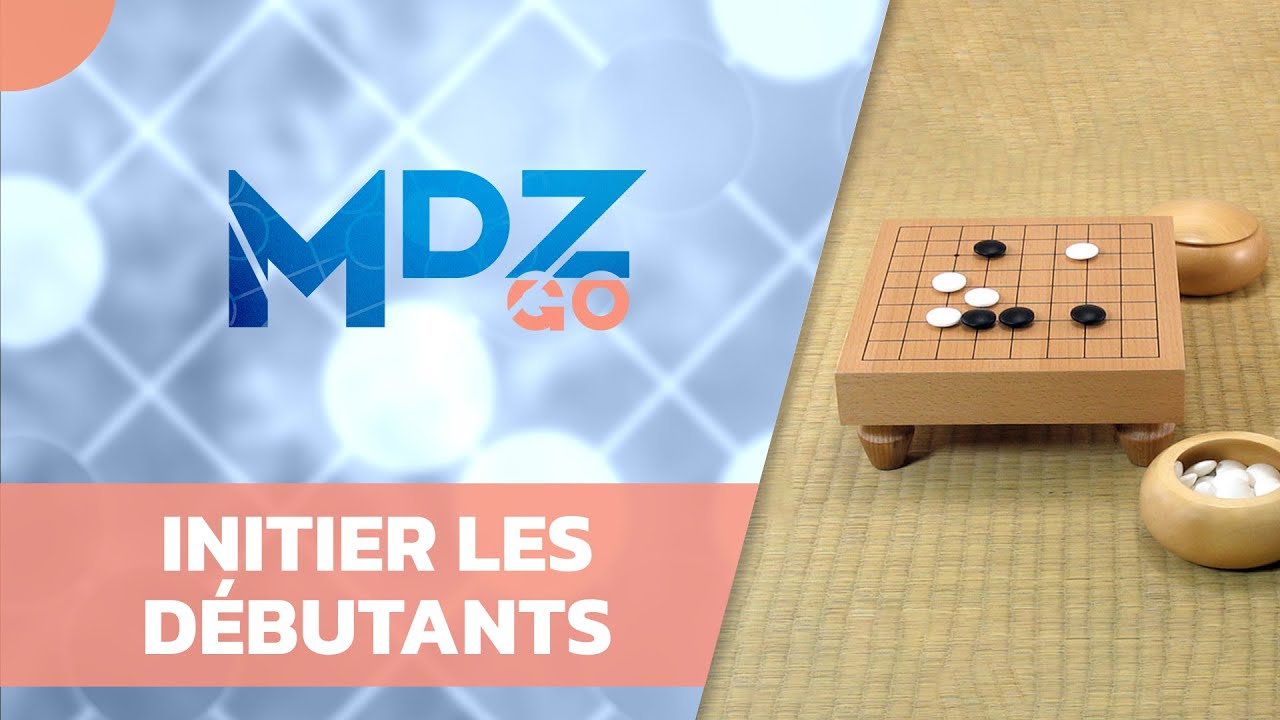
There is also this video by MDZ on how to teach beginners. It’s in French but you can auto-translate subtitles if necessary.

2 Likes

Here’s my current hypothesis on what’s the best approach to teach people with no prior knowledge, short version:

  • short rules explanation (only what they need to start playing)
  • [encourage them to play] early and often
  • answer questions (don’t explain stuff they didn’t ask about)
  • let them win (if you play)

This approach focuses on

  • let them explore the possibilities themself (e.g. if you explain seki out of context, you take away their possibility to discover it on their own.)
  • give room for them to engage by playing and asking questions
  • give them positive feedback (by playing and winning)
3 Likes

Doesn’t work for me.

You need two steps.

  1. Auto-generate subtitles in French
  2. Then auto-translate in English.

If that doesn’t work, or if the translation is too bad, I’ll summarize the video later today.

1 Like

Before going to China, I had multiple teaching time. The one I didn’t practice was private paid lessons. I teached groups (adults in summer go camps and children at school). I wrote in the french review (some articles about forgotten Chinese concepts). I teached a large bunch of individuals too (in clubs mostly). In China I haven’t teached a lot, mainly some beginners in face to face (Chinese tourists in guesthouses). Instead I studied, exploring the other side of the relationship. Nowadays I’m still exploring a bit, teaching on internet from time to time.

For the most part I elaborate most of the teaching myself. But it did happen, in some informal exchanges. One time for example I teached in a school in Switzerland together with Yuki Shigeno, a pro player who was secretary of the world go amateur association and who indeed had a lot of experiences in teaching (and promoting too).Another great teacher which I spent some times with was P. Aroutcheff, someone who played a major role in the spread of go in France (teaching, books, articles in Science et Vie, a french sciences magazine). Got more exchanges on teaching with others, and all these was more kind of good friends relationship, all passionate and invested in sharing what we know on the game.

I have only followed the birth of this diploma and haven’t participate in it. The main motivation seemed to be recognition for the government education sector. I hope some french players could provide us what they know about it or their own experience.

1 Like

Honestly I don’t think so.

The nuance is for a part in the word “efficiently”. When you say practice is sufficient, there is already an underestimation of the knowledge brought to you by your opponent.

There are often steps in the progress of the player and pulling him out of it becomes a challenge for the teacher.

For a majority of players the discovery of the game comes with frustration of not being able of a minimal knowledge to reach some goal. It’s not that easy to help to overcome it.

In my opinion there are different ideas, process, concepts which you integrate one after the other, and this is quite similar with what someone experiences in mathematics, you can’t really jump ahead and you will have to practice one before discovering the next. Even you have to reassess sometimes things that you thought were granted. For what I saw the help of a teacher by reviewing some of your moves is immensely valuable in that sense. Not so easy to discover that what you think good was wrong (and the reverse)

Playing a lot is more as a good method, especially for weaker players who need to build quickly some experience. Non stop is where I may not be so sure about the efficiency.

1 Like

I think it overlooks the main advantage of 9x9, it’s a shorter game overall.

If you compare how beginners play, even 9x9 games can be long, so 19x19 can be three times longer or more.

Basically it’s much easier to let someone get a feeling for all parts of the game quicker on 9x9. Or even 13x13 if they don’t like 9x9.

Except for some people you’re going to have to do it in a convincing way, because a number of people really don’t like when you let them win.

Let’s say they know you’ve been playing for 10 years, and they beat you in the first game, a lot of people can tell something might be up.

It can frustrating for some people to know you’re not trying your best.


If you were trying to summarise the best method of teaching new players, is it a good idea to have advice that doesn’t consider asking the new player what they want?

I think it’s different if it’s a Go school the player signed up to, or if it’s a player that just walked into the club that wants to play or learn.

2 Likes

We might find it hard to describe what “efficient” or “effective” (I think were using both words) really is, but maybe I can give an example of what I think isn’t efficient or effective.

Examples like this come to my mind a lot when I look at older Go books.

What can happen is their content and coverage is really good, but their explanations are lacking, maybe intentionally.

Some people will argue that you should figure out for yourself why Black 1 is best, and then the learning will stand to you.

But reinventing the wheel isn’t necessarily efficient even if it somehow stands to you.

If the person writing the book is a 5dan, they know exactly why Black 1 is best and you can probably fit it into one sentence like “It leaves potentially better endgame for black than the usual shape point”, or if not and white answers you live in sente.

I know a lot of answers in Go are really “it depends”, but giving no hint at all as to why one move is better means you’ve lost an opportunity to teach something at a critical moment where you could teach something.

I think a Go player can go years without actually figuring out small things like that, living with a descent rather than living with a move that has little impact on the rest of the board.


It’s not a criticism of the contents or the authors necessarily, but a criticism of the style that hints at something but never says it. I think that’s inefficient especially if the explanation is genuinely short.

It might be that the “good” player or student figures it out, another player works hard and figures it out but could’ve spend the time on other things, and then there’s players that don’t figure it out, give up and move on, or just put down the book and don’t come back to it.

I think it can also leave an opportunity for a learner to mislead themselves in thinking they know the reason for something, but because there was no answer given, they might hold onto a misconception for a long time.

I think I can find a lot more examples. I’m reading some of these kinds of books again, so I can probably dig some things like that out.

2 Likes

Yes, because “game theory” is “math about games”, while Go is a “game with math elements”.

Similarly “playing pool/(billiards) is part of physics” with all those spins, curves and collisions, but all tactics about teaching physics, have nothing to do with learning pool. Physics is a science, pool is a game. Most people learn/do science for totally different reasons than the ones they choose play a game for, thus not only the activities are different, but also the motivation.

2 Likes

In writing a book there is a balance to take care of. You talk about opportunity lost for a complementary explanation, but that’s an opportunity to put 1 problem more. So like you, at times, I wished a bit more explaination but maybe I was simply a bit under ranked to read that book. I had these thinking especially in the time being DDK with those books. For example I understood that a double point jump on the third line may constitute a base for life but those books never showed me sequences if you tried to disrupt their link.

1 Like

A lot of time we’re talking about one sentence. A problem is going to take up a lot more space than one sentence. To be honest it’s more so finishing the sentence you started even. “Black 1 is best since/because…”

If you know everything in the book then you’re reading it more like a novel.

I think you have to be a little lower than the level to get a lot out of it. Ideally it’s teaching you something new.

Davies tesuji book for example as a ddk is great because so many things are new, and can be applied somewhere in a game, maybe not every game.

2 Likes

Tesuji has a special place in my heart because it’s really an introduction to them, not already at some intermediate level. If you do the problems seriously it may require like around 10k level. The introductory chapter could be skipped especially at that level… That was the first book I studied with putting each problem on a board, including the first explained ones for each chapter.

1 Like

Quick summary of the video:

  • Adapt your message to your public (adult who plays other board games, adult who doesn’t play other games, children, old people,…)
  • Your primary goal should be that the beginner has has a good time so that he wants to comes back later to the club
  • Don’t overwhelm the beginner, say as little as possible
  • It’s better if there is only one teacher for the beginner, instead of several people giving simultaneous advice.
  • Explain the rules: players place stones alternatively, starting with black. Explain liberties. Ask him to capture a single stone. If he uses 6 stones, say that “this is very good, however there are two useless stones, which ones?”.
  • Same thing with two stones, tell him to capture them.
  • Now he is ready to play an atari-go. Start with a cross-cut. MDZ doesn’t call that a “cross-cut” but the “position of the Panda”, children like the name better. Tell him that it’s an ancient asian game, we start by telling each other “have a nice game”.
  • Don’t play the best move. Don’t play too badly either, but play suboptimal moves so that you don’t crush him. Create a complicated position so that the beginner isn’t aware that you are underplaying, don’t win the game too fast.
  • Don’t be afraid to play bad moves and teach him bad habits. He won’t remember bad moves, instead he will remember the good time he had.
  • Try to setup a position where he can capture your stones in a ladder, let him discover the concept.
  • Praise him if he notices ataris, or if he manages to capture your stones
  • After a couple of games, setup a position where he can play a double atari and ask him to play.
  • After a few games, the stones will approach the first line (line of death), let him discover its properties and capture your stones.
  • It’s OK to lose a teaching game from time to time. If he succeeds, say “thank you for the game” and start a new one.
  • After a few games, if he didn’t understand it already, explain explicitly the concept of ladder: “White gets out, and Black blocks”
  • Once he understands atari-go, capture, line of death and ladder, explain the concept of territory. Setup a position with Black at C3, C5, C7, E3 and White at the symmetric position. Say that the goal of the real game is to make territory, and play endgame from this position. Play suboptimal moves so that you don’t crush him, try to make a close game. Explain how to finish the game, that you don’t play in the opponent’s territory or in your own territory. Also, explain that suicide is forbidden.
  • After a few games, start with 3 black stones and 3 white stones.
  • After a few games, start with 2 black stones and 2 white stones, etc.
  • Once you have played a few normal games, explain the concept of eyes: ask him to capture a group with one eye and a group with a 2-point eye. Then show that a group with two eyes is “immortal”. Say that if you are afraid to die, then surround two “distinct intersections” to make your group immortal.
  • Then advise him to play many 9x9 games on GoQuest or on OGS, in order to gain fighting experience.
6 Likes

I know this might sound counter-intuitive, perhaps even ridiculous - but for me, the biggest impediment to teaching Go effectively to 25-30 kyu players is that the teacher can no longer remember a time when they didn’t speak and think in the language of Go.

Perhaps I can use false eyes as a good example. To an experienced player, it can seem quite rudimentary to explain basic things like why a shape needs 2 living eyes. However, as a 25-18 kyu, being able to spot the shapes that will inevitably end up as false eyes can feel like a long and difficult struggle - even with help from sensei’s library

Because beginners haven’t absorbed that experiential learning, they feel like they have plenty of room to make those eyes, only to realize that their own stones fill in those spaces when challenged with forcing moves, etc…

And that’s just a tiny branch of a much larger, varied tree of interconnected experiences that they need to absorb - understanding when it’s time to tenuki, the nuances of territory vs influence, using forcing moves to control direction of play - all of these are an interconnected web of abstractions comingling with other abstractions

Once we learn to speak that language and think in it - it can be very difficult to think back to what we were like before we understood those concepts - and figure out how to build a bridge in between

Another good metaphor for experiential learning - besides the martial arts metaphor I mentioned earlier - is camping and survival skills. So a 25 kyu would be someone going camping for their 2nd or 3rd time, with a full kit of sleeping bag, tent, prepared food, gas stove etc, and they still might end up on the wrong side of a mountain, drenched in rain, and losing some of their stuff.

A 9 kyu would be someone who could go out with a backpack, tent, and compass - traverse terrain with no trails using only a map, and fish in some isolated lake for days without needing to pack in food.

A 9 dan would be someone who just took the most basic survival gear and tools, and built their own shelter from natural materials, and survived for weeks on food they caught.

Technically, all 3 of these are “camping in the wilderness” but there’s a broad range of skills there that can only be learned through experience. As such - if someone’s starting from scratch, it makes sense to start with the basics / fundamentals, and then slowly add particular skills as the person’s skill level rises to understand how they fit into a larger coherent whole. Teaching someone how to make a friction fire or build game snares (i.e. advanced survival skills) may be fascinating, but difficult to apply as a beginner.

I guess this is a long winded way of saying that for me, the skills gained from tsumego and the type of contact fighting often found in 9x9 are much more useful to players between 12-8 kyu - players who already understand fairly complex fundamentals like the stages of the game, proper use of direction of play, when to try to live small and when to escape.

In my experience, 25 kyu players who go from a steady diet of 9x9 and tsumego to dipping their toes into 19x19 often tend to

  • start contact fighting early
  • ignore corner > sides > middle
  • ignore directly of play
  • follow the contact fight wherever their opponent plays (i.e. capture go / puppy go)

So yes, of course I see the value of correctly reading life/death as a necessary skill for getting good at Go, but as an introduction for beginners, I feel like it distracts them with a “one correct answer puzzle” and provides a poor guiding light in terms of a way of understanding a much deeper and more varied game mechanic which is the 19x19 game

My 2 cents - your mileage may vary - some cars not for use with some sets - void where prohibited

6 Likes

The video of MDZ deals with complete beginners, who have never touched a go stone. Once they have played their first few games on 9x9 to learn the rules (no suicide, two eyes and concept of dead stones, how to finish the game) he recommends to continue on 9x9 in order to play and lose many games. Of course at some point, when they start to see ataris, are aware of properties of the second line, are aware of lack of liberties, etc. they can switch to 19x19.

And at the beginning of the video, MDZ says that his way is not the only one, there are many other good teaching methods.

That said,

Puppy go is not specific to beginners or people who play a lot of 9x9. I’ve recently been reviewing a bunch of games with AI-sensei, and found out that I still occasionally play puppy go. For instance, here are two positions where I am very tempted to follow the opponent’s last move, but AI thinks it’s a mistake.

Position 1

Position 2

4 Likes