This is art. I might be a better Go player for now, but you win in artistry.
2 Likes

they thought they disarmed my square
8 Likes
A new square fortress has been constructed: this one only loses about 4 points according to OGS score estimate. It’s not very creative but if I respect my opponent and I’m trying to win, I think I’ll default to playing this.
3 Likes

also not quite square opening, but Go Seigen played a lot of tengen games and stones near the center in the first 10 moves. My favorite Go content creator covered one such game, I highly recommend watching it to anyone trying to get a better understanding with which to view our amateur low dan/SDK games:
1 Like
if you play 2nd stone on the side in empty half of the board, then you can choose which corner to take, possible after any move of opponent
3 Likes
but if my opponent is crazy enough to attach on top of my 2nd stone (10-3 point), then it’s weaker than playing 3-3 point as the 2nd stone. If my opponent tries to break my current opening, I can defend the 3-3 stone much more easily and keep sente, which I can then use to continue my opening using another corner.
2 Likes
When opponents attach to my square instead of taking corners, they just get less points compared to if they took corners. So, I’m ok with that, I continue to build square until it completed.
2 Likes
In the event that the opponent tries to break the square, I’d rather have corner instead of side. In the screenshots below you can see the difference – playing 3-3 on move 2 allows for a more connected framework.
Here is tengen to 10-3 (side) on move 2:

And here is tengen to 3-3 on move 2:

Black gets an entire side to himself because if White splits again at move 6, then Black would be able to take 3 corners plus tengen, which is a slightly easier game for Black. Of course the first screenshot is not that bad for Black, but it’s not the style of game I want to play when I choose to start at tengen.
1 Like
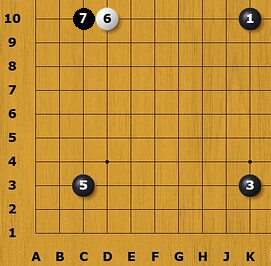
That move alone loses 4 points, compared to all the other moves which lose less than 1 point at most. This version of square fuseki is meant to be the most competitive, even against professional players, so that’s not an acceptable loss. Even if we ignore AI estimates, attaching under White’s stone like that immediately allows White to win on that side of the board because he has “high ground” advantage and sente (first turn advantage).
Artistically speaking, I wouldn’t care much about losing 4 points if it means completing a beautiful square. But this attachment is not beautiful compared to making a clean square in the center of the board. Also, the resulting framework is not fitting for tengen style – it would be a mix between center influence and territory on the 3rd line. I want a unified framework that connects to my tengen stone for easier strategic thinking and decision-making.
Here’s a demo board with some of the variations:
2 Likes
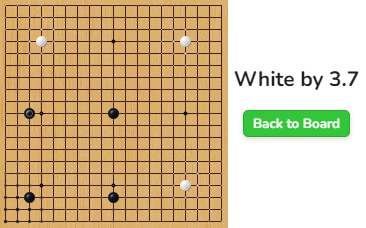
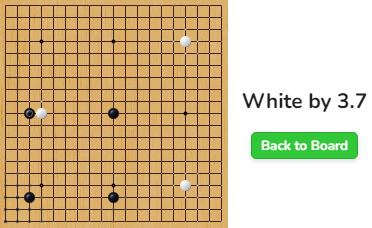
Points-wise it loses nothing. In terms of psychology it loses a lot. The purpose of square fuseki, at least this one, is to keep the opponent weak and split up on all parts of the board while you are strong. W+3.7 with an untouched, clean square framework is better than W+3.7 with a strong White group that breaks Black’s framework.
I explained in one of your played games that W+12 meant nothing because it’s almost impossible for any kyu player to execute the fight and find the right timing to tenuki in order to make the game result in W+12 points. Even though the score estimate said W+12, probably 90% of kyu players would lose the game as White from that position.
Forget what I said about the move losing 4 points. The reason it’s bad is not related to points. It’s bad locally and strategically.

You have no psychological advantage in this game.
2 Likes
is to have square
5 Likes
Well that’s not why I play it. If all I cared about was drawing and not winning, I would draw a dinosaur head or smiley face, not only squares. My goal is to have fun and win, not only to have fun.
2 Likes
That’s fine. I’m just telling you the goal of my version of the fuseki is to split the opponent on all parts of the board, making sure they don’t have 2 eyes anywhere, even their own corners. I can attack anywhere anytime and not worry about my own territory/safety because I have a 3-3 corner, which is almost always going to be alive.
Tiny square in center is much easier to play than my big square, so yes it can be the best psychological advantage for you.
1 Like
finally beat a 6d (was 5.9d at game start), using my new square opening: 友誼對局
I also came very close to beating him when he was 6.0d, but I ran out of time at a small endgame ko: 友誼對局
4 Likes
Very interesting game. Congratulations! 
1 Like
Not nearly enough, until I reach my original goal of maintaining a consistent 5 dan rank and beating a 7 dan (who is trying his best) with square. But I’m surprised myself at how little time it took to beat a 6 dan. I’ve never done that in my life, even with normal openings.
+1, I improved more with square fuseki in the past 2 months than I did playing Go for the past 5 years using more standard openings. It’s simple, consistent, and as an extra bonus it’s fun – we surely learn more when we’re having fun. But logically speaking, when you play joseki, the entire 10 moves or so that you and your opponent play out a joseki sequence, you’re basically not using your brain other than recalling a sequence of moves from memory. It’s like AI is playing the game (in the case of AI joseki), you’re not the one playing during those moves. How can you improve fast if 10~20% of all of your moves on a goban are not using your brain? Square fusekis generally use much less or much simpler joseki and get into invasions and fighting much earlier in games, meaning more of your time is spent actively evaluating the board or reading variations, and that’s why it’s better for improvement.
2 Likes
Good point! By the way I was going through the game, is this variation viable:

Most of the moves seems sente to me, but I am not on the dan level. Maybe 17 is not sente, but at that point White could just skip it and play 19? Would that have given enough space for two eyes?
Or maybe, if Black resists, then n4 is sente, as well? As far as I can tell only black at m4 “works”, but still White is alive since Black as to defend from the double atari, and White can make two eyes now at h5:

Alternatively to playing 23 at k4, maybe n3 is also good? But that seems like a tough fight.
1 Like