Sai decided to end his life at Uji River after he felt the weight of his tarnished honor become heavier than the water itself. As his body sank into the cold depths, the silken robes of a royal tutor blossomed like a dark flower before being weighed down by the silt of the riverbed.
Days later, his body was found by local fishermen downstream, near the outskirts of the capital. Recognizing the high-quality fabric of his robes but seeing the brand of a disgraced official, they reported the find to the palace guards.
The response from the Imperial Court was cold and swift. Because Sai was officially labeled a “cheat” and a “criminal” who had insulted the Emperor’s game, he was denied the sacred rites of Fushibi (cremation). The officials ordered that his body be treated as Kegare—a source of spiritual pollution.
Without a coffin or a prayer, his remains were wrapped in a coarse straw mat and hauled on a cart to the desolate fields of Toribeno. There, in the “Field of Falling Dew,” his body was not buried, but abandoned to the elements. This was the Fuso (wind burial), where the elite of the city threw those they wished to forget.
While the birds and the mountain winds slowly reclaimed his physical form, the palace struck his name from the official records. No stone was laid; no incense was burned. Within a year, the tall grass of Higashiyama had completely hidden the spot where the greatest Go player of the Heian era had returned to the earth.
To the world, Sai became a nameless skeleton in a field of ghosts. But because no one performed the rituals to guide his soul, and because his heart was still gripped by the “Divine Move,” his spirit remained trapped—not in his bones, but in the blood-stained Go board he had cherished in life, waiting for a thousand years for someone to hear his plea.
TIME SKIPPED
***
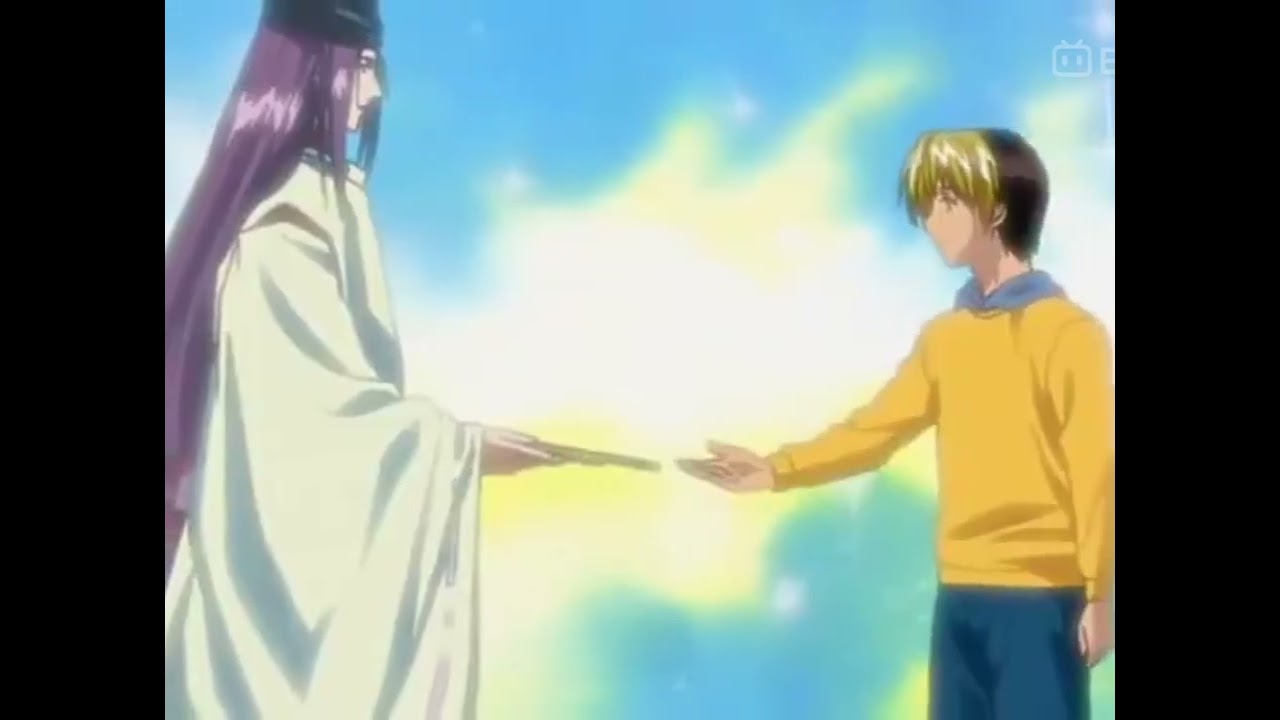
After Sai’s ghost showed a divine move by Hikaru, the ghost felt relieved and had no longer any purpose to stay in the human world. He faded into the light, leaving Hikaru with a heart full of both gratitude and an ache that wouldn’t subside.
Adult Hikaru kept searching for clues about Fujiwara-no-Sai’s history, driven by a need to give his teacher the dignity the Heian era had stolen from him. After 19 years of searching through ancient scrolls, cross-referencing forgotten maps of old Kyoto, and consulting with specialized archaeologists, Hikaru finally found the remains of Sai’s body in Higashiyama.
It was a secluded, overgrown corner of the old Toribeno site, far from the modern walking paths. As Hikaru carefully brushed away centuries of packed earth and tangled roots, his breath hitched. There, among the fragments of a skull that had once held the most brilliant Go mind in history, lay an object that defied the passage of time.
Hikaru was still familiar with the ougi (the traditional fan) that the ghost of Sai often brought with him. It was the exact same design as the one Sai had passed to Hikaru in his final dream. Despite being buried for a millennium, the ribs of the fan remained intact, tucked protectively near the remains of the skull. The silk was tattered and stained by the earth, but the elegant curve of its frame was unmistakable.
Seeing it there, in the dirt, made the ghost feel real in a way the spirit world never could. Hikaru didn’t see a criminal or a disgraced tutor; he saw his friend. Tears blurred his vision as he reached out to touch the wood of the fan.
“I found you, Sai,” Hikaru whispered, his voice thick with nearly two decades of longing.
He didn’t leave the remains in the cold ground of the ‘forgotten.’
But instead of bringing peace, the sight of the tattered fan ignited a desperate, reckless fire in Hikaru’s heart. He wasn’t ready to let go.
Hikaru decided to perform shamanic rituals to drag back the ghost of Sai. He had spent years secretly preparing, obsessed with forbidden texts and ancient spiritual practices that promised to bridge the gap between life and death.
He brought Sai’s remaining skull and his decayed silk clothes to a secluded temple deep in the mountains, under a moonless sky.
Hikaru began the ritual, chanting the old Heian verses and pouring his own energy into the circle.
For a moment, the air grew freezing, and a familiar silhouette began to form in the mist. Hikaru’s heart leapt—the long, flowing hair and the tall headdress were exactly as he remembered.
However, something went wrong.
As the figure solidified, Hikaru realized the aura was not the gentle, pure light of the Sai he knew. This entity radiated a very evil aura, thick with a thousand years of repressed resentment and the “kegare” (impurity) of the restless dead.
Its eyes were not kind, but hollow pits of cold malice.
Before Hikaru could break the circle, the dark ghost lunged forward. It didn’t embrace him; it shattered him.
The dark spirit of “Sai” entered Hikaru’s body, surging through his veins like liquid ice. Hikaru’s own consciousness was pushed into a dark corner of his mind as the entity took full control.When “Hikaru” stood up, his eyes had changed—sharper, colder, and flickering with an ancient, vengeful light.
He picked up the fan, snapped it open with a sound like a bone breaking, and smiled. The master of Go had returned, but the man who had summoned him was gone, buried alive within his own skin.
TO BE CONTINUE.
***
Hikaru no Go: Re-Birth of the Dark Master - Volume 1