Land rent, its burden on the economy, and the solution

I mentioned Henry George’s book Progress and Poverty in the reading thread, and there was some interest in the subject. Here’s a thread as promised. @garlicsoup @JethOrensin

I’m not exactly sure how to start us off. It took me a while to fully underestand this idea, and I’ve found introducing people to it with few words and minor effort on their part is difficult. So I guess the best I can do first of all is to motivate you.

On that note, when I was introduced to this it was like a volcanic eruption in my political and economic consciousness. It’s likely the most important idea you’ve never heard of. For me, it was the sort of idea that made all the other ideas seem almost silly. We argue about details when the solution has been right there in front of us for 150 years.

We all know about wealth inequality. We talk about it all the time in politics, and we all have our opinions on its causes and solutions. It turns out that Henry George convincingly identified one of its major causes, if not the primary cause, all the way back in 1879, and it has been all but forgotten. You’ve probably never heard of him, but at the time he and his magnum opus were actually quite popular. In the 1890s, Progress and Poverty came second only to the bible in UK sales.

Why have you not heard of it, then? Well, the reasons for that are political, and we can get into that, but that would be putting the cart before the horse. First, the economic argument needs to be understood. I’ll write a short introduction, but don’t expect to come away from this post fully understanding it. By all means ask questions, but you’ll probably need to do your own research as well. There are resources online to deepen your understanding, and you could always read the book of course.

Land rent

The first thing to understand is economic rent, which is a factor when a resource used in production is in limited supply. Land is the most important such resource, and land rent is therefore the most important example of economic rent (monopolies from intellectual property are another). Let’s start with a quick example of land that yields rent: Consider land in the heart of Manhattan. This is in very high demand, yet in fixed supply. Normally when things are in high demand we make more of them. We cannot make more land in the heart of Manhattan, so it yields rent.

David Ricardo’s law of rent states that the rent of a land site is equal to the profit obtained by using the site in its most productive use, compared to using marginal land for the same purpose, given the same inputs of labor. You might want to read that a few times. I’ll explain it with a hypothetical:

Imagine you own two plots of land, both in the middle of nowhere (both “marginal”). You lease them to farmers who pay you some monthly fee for permission to use your land. This fee is not very high, because marginal land is not in high demand. Now imagine that near land 1, a city develops. Because of the city nearby, the farmer on land 1 is able to build a significantly more profitable farm than farmer 2. Land 2 is still marginal, and land 1 now yields rent. The rent of land 1 is equal to the profit obtained by using it in its most productive use, compared to the profit obtained by using land 2. Therefore, the law of rent states: The rent of land 1 is equal to the difference in profitability between farm 1 and farm 2.

Remember, there is a fixed supply of land in and around the city. Farmers who are competing for farmland to build a profitable farm on will therefore be willing to pay you, the landowner, a high price to use land 1. Normally when things are in high demand we make more of them, and the price would come down, but here that can’t happen. In practical terms this means that you can raise the price to such an extent that farm 1’s additional profits are wiped out and ultimately go to you, the landowner. This is the key insight, so make sure you understand it. Developments nearby, created by the community, enable more productive use of land, but the value that is added by this more productive use ends up being turned into land rent and is extracted by landowners, who contributed nothing in creating that value.

Consequences

When you buy real estate, whether it is to live in yourself or not, you also typically buy the plot of land underneath. The price of that plot of land includes centuries of accumulated rent. It is here, in the land rent, that much of the value added by centuries of economic growth is stored. Globally, we are talking hundreds of trillions of USD. Directly applicable to you and everyone else who needs a place to live (which is everyone) is the fact that your mortgage payments or monthly payments to your landlord would be significantly lower if you were not paying for centuries of accumulated land rent. Indirectly, it affects everyone because it makes production less efficient. Refer to the image above. The one doing all the work in using the land productively doesn’t reap the benefits. Land rent eats into their profit margin, which ultimately has to be passed on to the consumer. And these are just the economic effects. What about the justice of it? Why should landowners, by “virtue” of owning the rights of others to exist somewhere on earth, get to reap all the benefits of economic growth?

Does it seem a little strange to you yet that this is not typically mentioned as a primary cause of wealth inequality? If so, welcome to the club.

The solution

In Progress and Poverty, George makes what I believe to be a convincing argument for how to solve the problem. The solution, in his mind, is to capture land rent so that the returns don’t go to landowners but to the collective, so that everyone can share in the benefits of economic growth. We can achieve this by simply confiscating all land and leasing it to its users for a fee, effectively making the government the landlord of all land. But confiscating all land is a legal hassle, and there is a cleaner way to achieve basically the same thing: Taxation.

Let’s quickly note that when we tax something, we discourage it. When we tax alcohol consumption, we discourage it. When we tax income from labor, we discourage labor, even if we don’t want to. When we tax production (companies), we discourage production. In economic terms, when we tax something, supply and/or demand will decrease. Here’s a neat interactive visualization. Now remember, land is in fixed supply (supply elasticity = 0). Taxing it will not affect its supply. A tax on the value of land is therefore an economically efficient tax.

The proposal is this: A 100% tax on the unimproved value of land. (Land value tax, or LVT).

This means we are only taxing the value of the land itself, not the value of any improvements on top of it. The owner of an empty plot of land pays the same amount in taxes as the owner of a plot of land next to it which has an apartment building on it. We are only taxing any value that was already there, or added by the community, not value that was added by the owners of the land or its users. This way, we don’t discourage the improvement of land, which modern-day property taxes do. A high tax on the unimproved value of land is both more just and more economically efficient.

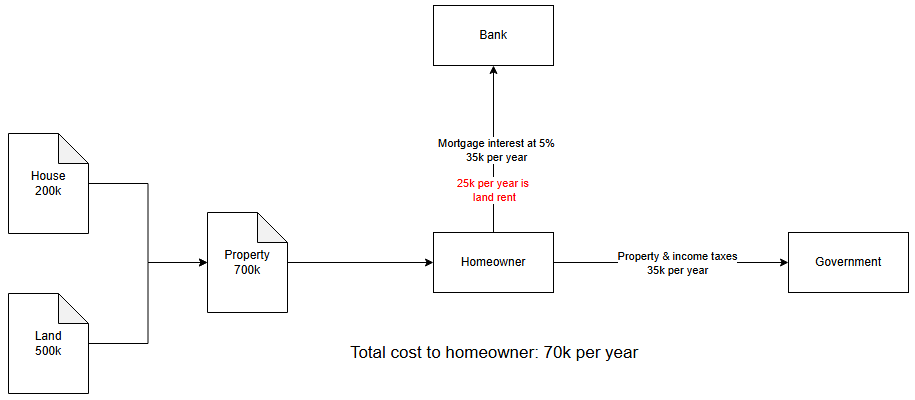
Imagine you owned a $300k piece of real estate. Currently, in locations with moderately high land rents, about half of that is the price of the land. About 1/20th of this 150k is the yearly land rent, which we would be taxing. This would be $7500 a year. The most important direct consequence is that it would no longer be worthwhile to hold land and lease it to users. After all, users would be willing to pay you $7500 a year to use your land, but you owe all of that in taxes. The price of land drops to almost zero, which means the price of the property drops to about 150k. If mortgage interest is 5%, meaning your mortgage payments are reduced by $7500, this means you end up with the same direct monthly cost of living as before.

But there’s an important difference between the situation pre-LVT and post-LVT: Your monthly payments are no longer all going to the bank. Half of them are now going to the state, meaning the state’s revenue increases significantly. This means it can partly replace other forms of economically inefficient and unjust taxation with this more efficient and just tax. It can significantly lower income tax rates and corporate tax rates, to the point where you, the owner of the house from the example, are directly better off than before, and it’s only the bank that loses.

Below is an illustration of this point. We are buyers of a real estate property in an urban environment where land is expensive. Remember this is just an illustration. The numbers won’t translate exactly to real-life results but close enough.

Current:
Post LVT:
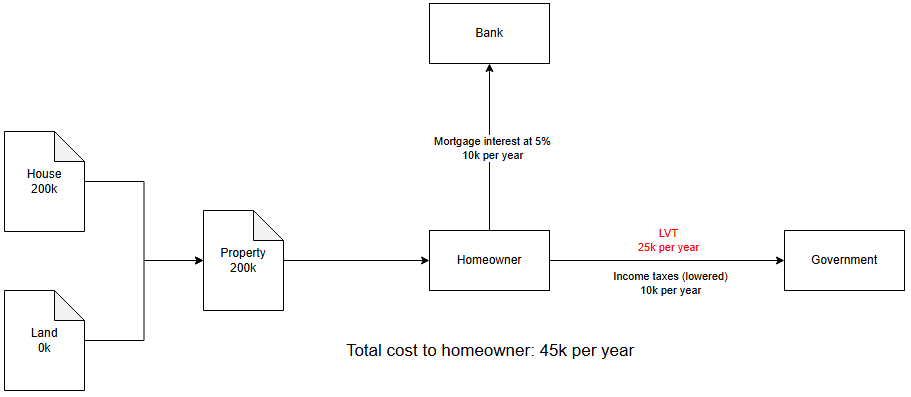
The government can lower income taxes, which are both inefficient and unjust, and still retain the same amount of revenue because the revenue has been replaced with a more efficient and just tax. It would be a (partial) shift of the tax burden from the productive part of the economy to the unproductive, parasitic part.

The effects of the resulting improved economic efficiency are hard to overstate. The burden of rent on an economy is absolutely huge, as I hope you now understand. GDP growth would increase sharply, and of course with the LVT we are actually capturing that growth for the community, rather than having it be extracted by landowners passively.

Thanks for reading, I look forward to any responses.

4 Likes

This is what China does. And their GDP has indeed increased sharply! :exploding_head:

Thanks for this great presentation of the idea. My quick response is that this seems like one major case of the principle that capital tends to accumulate. I.e. the landowners gain rent and acquire more land (or other assets) the same way factory owners use their capital (primarily invested in machinery, let’s say, moreso than the land) and can re-invest profits as more capital.

On its face this seems like a terrible idea to me because it would immediately place an enormous financial burden on rural people and lead to their land being acquired by wealthy people and corporations.

Surely I am not understanding this idea fully but it seems like it would be impossible to live as a subsistence farmer in this model.

3 Likes

Along the same lines.

Such a policy would actually require that landowners convert their land to profit-making uses (or lose it to someone else who will). Certainly this would increase GDP but the externalities would be very high, possibly disastrous, as every “unproductive” wilderness (of course very productive in terms of ecology, plants, animals, oxygen for us to breathe, and so forth) would have to be replaced or managed or exploited.

6 Likes

“Hey, why should people that own something benefit from it?”
Asked someone creating a problem where none exists.

“I know the solution!!!” Said the same person:

Let get that money and give them to some other people that not only have nothing to do with that property or that community, but most certainly do not contribute to the community. :rofl:

This, in a nutshell, is the ridiculousness of that proposal.

This is laughable.
In practice, this means that those that have the capital to improve on the land will eventually outlast the people that don’t and will hoard more land, thus creating more inequality, instead of less.

Ah, yeah, because taxes are so well managed… :sweat_smile:

The economy would have collapsed so fast that you’d need to invade a few countries just to make them “share your rent”… :wink:

Hyperbole aside, my honest opinion for that idea is that it was the 1890s idea of a PsyOp made by the ultra rich. If that idea had caught on, the land would have been redistributed to favour of the rich within a couple of decades. People from rich countries could even buy whole provinces in poorer countries, if that system was ever introduced, and we would have returned to feudalism within a couple of generations.

Here is are a few simple questions for you @mart900 so that I can estimate which usecases of the system you understand:
1a) Do you own any productive land? (a farmland, a plot with trees or something similar)
1b) If “yes” do you rent it out or do you cultivate it yourself?

2a) Do you own a house which you live in?
2b) If “yes”, did you build it yourself or buy it or did you inherit it?

3) Do you own a different residential property which you rent to others for them to live in?
3b) If “yes”, did you build it yourself or buy it or did you inherit it?

For your consideration, this main supposition of this system is where it mostly goes wrong:

This sentence, as is being stated is false for two reasons:
a) It places the owner of the land outside of the community, when the landowner is a de facto member of it.
b) It supposes that there is some “magical community” which eventually comes along whose motives are to generate growth, but it forgets that the community is made of humans and that there should be a motive for growth. If you tax the land too much from the get go, why would normal people invest in it to begin with? :thinking: There is neither motive nor ability for a normal person to get any land or build anything on it. Only the already rich can do that, but the author cannot say that, so the word “community” is used instead. :wink:

Oh, you are understanding it just fine. If you were a subsistent farmer, you’d just have to soon teach your children to call someone from the “local community”, Duke and Sire… :saluting_face:

3 Likes

I’m not sure I understand the proposal. The tax makes owning land uninteresting, so people will sell it to the state. Consider for instance a building in Manhattan. Would the state also own the building, or just the land?

2 Likes

Centuries of accumulated rent in the past? Then why?

Or centuries of rent that can be accumulated in the future?

I realized that, in my haste to finish the post last night, I forgot to mention something rather important. I edited it into the OP, starting from “Imagine you owned a $300k piece of real estate……”

Understand that the state has significantly increased revenue from the land value tax, and will be able to lower other, less efficient taxes as a result. The gain in economic efficiency when we (partly) replace income and corporate taxes with a LVT is absolutely huge. It’s also more just, because it’s a shift of the tax burden from the productive part of the economy (labor and production) to the unproductive (landowners sitting on land and pocketing the profits from accumulating economic growth).

When capital is used in production and the profits are used to invest in production, that is useful to the economy. That’s exactly what you want capital to be used for. When landowners sit on their asses and pocket the returns from economic growth by virtue of owning other people’s right to exist somewhere on earth, and then reinvest those profits to do even more rent-seeking speculation, it’s a burden on the economy.

On its face this seems like a terrible idea to me because it would immediately place an enormous financial burden on rural people and lead to their land being acquired by wealthy people and corporations.

Surely I am not understanding this idea fully but it seems like it would be impossible to live as a subsistence farmer in this model.

It’s a good point to bring up and it reminded me of what I forgot to mention and edited into the OP. That will serve as a response to your point.

I will add that an existing subsistence farmer in this economy, who already has a mortgage, would not be directly helped by the change because their mortgage payments stay the same. The price of their property would go down, but they aren’t helped by that. This would need to be addressed if we want to talk about going from the current situation to the LVT. But I wouldn’t want to get too deep into that before we agree that this is the direction we need to go.

1 Like

Unproductive wilderness does not yield land rent, so it would not be taxed.

1 Like

Whether the state owns the land and charges its user a yearly fee equal to the yearly land rent, or it doesn’t own the land and charges the one that does a 100% LVT, doesn’t matter. All of the land rent is being captured by the state in both cases.

Would the state also own the building, or just the land?

Just the land. If the user of the land decides to build a building on it, they own that building and they would not be taxed for it at all, as the LVT would fully replace property taxes.

What I mean there is that economic growth is “stored” in the land rents. When the economy grows, and therefore land can be used more profitably, land rents increase. When the economy grows for centuries in a row, these increases accumulate and land becomes increasingly expensive even when adjusted for inflation. This is the primary reason we are still spending such a large portion of our paychecks just to be able to live somewhere, despite having become orders of magnitude more productive than 300 years ago.

I’m not sure you’ve understood, well, any of the OP, but in this case the fact that land would not be profitable to own anymore, unless you yourself use it in a way that is profitable enough to compensate for the tax you’re paying on it. Owning an entire province would not be as glorious as you imagine it to be. In fact you would be bleeding money. Nobody would want to own entire provinces, which is one of the major benefits.

Here is are a few simple questions for you @mart900 so that I can estimate which usecases of the system you understand:
1a) Do you own any productive land? (a farmland, a plot with trees or something similar)
1b) If “yes” do you rent it out or do you cultivate it yourself?

2a) Do you own a house which you live in?
2b) If “yes”, did you build it yourself or buy it or did you inherit it?

3) Do you own a different residential property which you rent to others for them to live in?
3b) If “yes”, did you build it yourself or buy it or did you inherit it?

This is irrelevant, of course, but I’ll humor you because I’m curious where you’re going with it. I assume you’re going to argue that this proposal would help me personally, and that’s why I’m arguing for it. Well, it would help me personally, but not for the reasons you might imagine. It would help me only indirectly, because it would make the economy more just and efficient.

I don’t own any farmland or rental properties, just the house I live in and the land underneath, which I bought by borrowing money from the bank.

a) It places the owner of the land outside of the community, when the landowner is a de facto member of it.

Not necessarily. I can own land on the other side of the planet, and just by virtue of owning that land, I would reap the benefits of economic growth near it. If you want to claim that makes me a member of the community, whatever, I’m not going to argue the point because it’s irrelevant to the economic argument for an LVT.

b) It supposes that there is some “magical community” which eventually comes along whose motives are to generate growth, but it forgets that the community is made of humans and that there should be a motive for growth. If you tax the land too much from the get go, why would normal people invest in it to begin with? :thinking: There is neither motive nor ability for a normal person to get any land or build anything on it. Only the already rich can do that, but the author cannot say that, so the word “community” is used instead. :wink:

Land wouldn’t be a speculative asset. You would buy it if and only if you intend to use it profitably, as opposed to currently, where you are encouraged to sit on an empty plot of land and let it appreciate in value.

Growth happens when individuals are incentivized to be productive. Individuals would be able to buy land more cheaply, and would be more encouraged to use it productively. Growth would happen more quickly than it does now, because we would be removing the economic burden of land rent.

Oh, you are understanding it just fine. If you were a subsistent farmer, you’d just have to soon teach your children to call someone from the “local community”, Duke and Sire… :saluting_face:

Ironic, considering we are living in feudalism lite currently, which is exactly what this proposal is meant to fix.

I understood that very well, which is why I was very clear - and this confirms it - that the only people that could actually even have the potential to own any land, would be already rich people.

How that creates more fairness, that’s anyone’s guess. :sweat_smile:

How is it “more just” to ask for money from something that does not necessarily produce money? Saying so, doesn’t make it so.

Assuming that we accept taxation as a needed part of the social contract, the only thing that makes sense (let alone has anything to do with justice), is to tax something that generates money in the first place. Otherwise you will just generate an endless “Οὐκ ἂν λάβοις παρὰ τοῦ μὴ ἔχοντος” (“you cannot take from someone that doesn’t have”) cases.

Even the ancients understood that obvious issue, 2000 years ago…

If you are broke, but own a piece of land, that won’t make you invest in it or pay taxes on it (how? you do not have any money anyway), but it will just force you to sell it. And who has the money to pay for the land and afford the tax and afford the investment and absorve any potential risk of this whole endeavor?

The already super rich. Congratulations!

You assume wrong.
I asked that in order to understand what is your extent of your knowledge about owning any land whatsoever.

Usually proposals like that (“eat the rich”, “defund the police”, “redistribute the wealth” etc) come from people that have no immediate connection or understanding with the issue at hand, which usually explains their enthusiastically naive endorsement of such slogan-level solutions.

Knowing whether I am discussing this issue with someone that understands it or not, is crucial in order to adjust how serious I am going to take the whole matter.

Nice pamphlet talk, but unfortunately in the real world the majority of land-owners actually just own relatively small plots of land for their own use, just like you. Here are some stats for your country according to google:

Hardly the lazy exploiters of the “economic growth of the land”, eh? :thinking:

The state will own the land, but somehow someone would decide that this is a stable enough arrangement to invest their whole livelihood on a land that they don’t own… for sure…

Simply put this not only institutionalises greed (which is a problem with our species, not a virtue), but it penalises anyone that wants to live in a “this is good enough/ I have all I need” kind of life, therefore it automatically imposes a certain lifestyle of constant greed and growth to every citizen “or else”.

Amazing success, for sure. :roll_eyes:

Good. Which brings me to the next questions:

A) Would you have taken that decision if the land you bought was taxed equally high with a house on top of it or not, considering that until you gather the funds and complete the house building process, that land would “be bleeding money” (as you said above)?
B) If a sudden crisis (like the current wars etc) had increased the interest rates or the cost of materials or you had a reduction of income and the house was not completed with the money you had borrowed on the timeline you had expected, wouldn’t the constant impetus of the tax would have almost forced you to sell? Alternatively, if such tax did not exist, wouldn’t it mean that you could be more flexible with your timeline and complete the house in a span of 3-4 years?

Would many normal people take the risk of owning land, taking a loan and building a house OR would that process be only/mostly left to “large constructions corporations” and REITs? :thinking: And we all know how well that’s going currently since most of the world is in a housing crisis even without that kind of tax…

This is where things are being totally unserious:
You are taking a very specific case (a rich land owner from afar), make a solution that dissuades that specific case, while you are shafting the more usual case which is actually people like you. People that take out loans, to build a house to live in and stay in the community which they own the land.

Here is part of my small town in 1974 (right after the Junta fell) from an official air photo:

Here is the same part today:

The vast majority of the added buildings where from local people that stayed here and grew up their families here, therefore these people ARE THE COMMUNITY and you do not need to tax them more in order to redistribute their own money back to them. :sweat_smile:

Not every place is “in the heart of Manhattan” as you mentioned above and not everyone is a “Speculative buyer of land”. A system needs to work everywhere and think of all posible usecases and the system you like does not, since its application would curtail the ability of normal everyday people to own land and have their own house and stifle the countryside and places where land is not “high value”, so no rich people would come in and “buy up the land” from a distance and get taxed by it. What does this mean? The devaluation and eventual decline of the rural areas.

We used to have a system like that you know (well, the turkish did) called Chiflik. This is what your system would generate in the countryside:

You can see the remnants of them in the old aerial photos. :slight_smile:
Here is a nearby place from the same aerial:

See, the “square”?

Those are the remnants of the “rich landowner’s center of operation/fortress” for the Chiflik that could be still seen in 1974… and we know that because that place is still called “Tsifliki” today… of course that area looks much better now with many more houses:

Who built those?
The local people. The “community” did.

Had you made the land “bleed money”, we’d still have the Chiflik of some rich fellow who would have been the only one who could afford it.

Again, how is that “more fair”, that’s anyone’s guess. :sweat_smile:

You assume that it is so, for everyone and everywhere… that’s one of the downsides of that system.
It is like listening to Americans talk about depreciation in cars, while all the people that think that “cars are a tool that takes you from A to B” are like “what depreciation??” :sweat_smile:

Do you know how much the land has appreciated in my area?
In some places it depreciated during my lifetime.
So much for “centuries of accumulated rent”… :smiley:

I have more to say for more of the usecases that the system you adore willfully ignores (about the pitfalls of productive land, the tax adding an extra pressure of always making enough money to pay for it or be eventually forced to sell, cases of natural disasters, cases of personal misfortune etc and how all these end up to the same funnel of “the already rich will buy the land”), but I’ll stop here for the time being because I think that going further into this would be beating a dead horse.

Tl;Dr;
There are good reasons why that ridiculous system is not around.

4 Likes

I think I’m still not fully understanding this. Let’s say I own ten acres of forest. It’s unproductive wilderness, not taxed. Then I start a sawmill with buildings and machinery. I’m cutting down trees and selling boards. My sawmill is not taxed per se but is my land now assessed as productive rather than unproductive and therefore taxed? So is it potentially an income tax by another name?

(I suspect that land value and land use are somewhat different in the places we live.)

Mmm, this is not quite so unambiguous because in the status quo you, hopefully, eventually pay off the mortgage and then your family owns something of value. In the adjusted version you never finish paying the higher price even if the property remains in your family for generations. Consequently it is also worth less and so your regular payments are not going to help your family, they are going to the government, which may or may not be spending them well.

By the way I agree with you that there is a lot of unfairness, to say the least, embedded in the existing system wherein a proletarian mass owns nothing because all pay goes to rent and survival.

I’m still trying to visualize the effect that your system would have on the urban rental housing market.

But I would say the drive to accumulate capital is part of what created that situation. I mean, is it not the underlying reason for the concentration of industrial workers in cities and factory towns? Incidentally this was done in various ways including depriving people of their rights to live on rural land.

I’m not sure that the following is always true:

Production isn’t inherently good.

And neither is tax money, by the way.

In my country tax money is generally used to build bombs and fighter planes and to pay banks interest for loans that were taken out to build bombs and fighter planes in the past.

If there was a way for tax money to be re-invested in the “community” for infrastructure and organic agriculture (and other projects that I like personally, ha ha) maybe taxation would seem more appealing.

2 Likes

I still don’t understand how a hugh tax on land would improve anything. Living in Manhattan would still be more valuable than living in the middle of nowhere, so people would still be willing to pay higher rents to live there than elsewhere, so housing wouldn’t become more affordable. And rich people would still be rich, they always find a way to invest their money.

2 Likes

You say you understand it, and I believe that you think you do, but then you make points that demonstrate you don’t. You would do well to approach this with a bit more curiosity and humility.

It is simply false that only rich people would be able to own land. Land would, in fact, be extremely cheap, because owning it would no longer be profitable. Consider the property from the last two images in the OP. It currently costs 700k. With a 100% LVT, the land price would go to (almost) zero, and the total price of the property is 200k. We (the homeowner) now owe the 25k in land rent to the government instead of the bank. Since the government can now lower income taxes, we come out ahead. The property ends up being significantly cheaper overall than in the current situation, therefore more accessible to people of less means. In any case, there is no reason why a person who bought a real estate property in 2025 could not also buy that same property under LVT conditions.

How is it “more just” to ask for money from something that does not necessarily produce money? Saying so, doesn’t make it so.

Assuming that we accept taxation as a needed part of the social contract, the only thing that makes sense (let alone has anything to do with justice), is to tax something that generates money in the first place.

When I say “the productive part of the economy”, I mean the part where capital and labor is invested to produce goods and services which would otherwise not exist. The land would be there no matter what. Investing in land is not productive. But that doesn’t mean it doesn’t generate money. Land ownership is unproductive, but it’s very lucrative, because of land rents. This is explained in the OP.

If you had a choice of taxing the productive part, or the unproductive part, which would you tax? Keep in mind that when you tax something, you discourage it.

I asked that in order to understand what is your extent of your knowledge about owning any land whatsoever.

Usually proposals like that (“eat the rich”, “defund the police”, “redistribute the wealth” etc) come from people that have no immediate connection or understanding with the issue at hand, which usually explains their enthusiastically naive endorsement of such slogan-level solutions.

Knowing whether I am discussing this issue with someone that understands it or not, is crucial in order to adjust how serious I am going to take the whole matter.

A very interesting approach. I would think that if you wanted to know how seriously you should take someone’s opinion, you would ask for their credentials in whatever field of science you’re discussing.

Regardless, the argument speaks for itself. It shouldn’t matter who I am or where I come from. Refute the argument, not the person presenting it.

Nice pamphlet talk, but unfortunately in the real world the majority of land-owners actually just own relatively small plots of land for their own use, just like you. Here are some stats for your country according to google:

Hardly the lazy exploiters of the “economic growth of the land”, eh? :thinking:

Not them, no. They are “victims” of the system as much as tenants are. They paid absurdly high prices for the land underneath their homes, and the banks who own the mortgages are drowning in $$.

The state will own the land, but somehow someone would decide that this is a stable enough arrangement to invest their whole livelihood on a land that they don’t own… for sure…

If that makes them uncomfortable, they can buy the land from the state for pennies and pay the LVT instead of the fee to use the land. Makes no difference to the state.

A) Would you have taken that decision if the land you bought was taxed equally high with a house on top of it or not, considering that until you gather the funds and complete the house building process, that land would “be bleeding money” (as you said above)?

Before I answer, understand that part of why we buy real estate in this economy is that we ourselves are engaging in land speculation. Real estate is the best investment you can make, which is why banks are so uniquely willing to loan large amounts of money to people who are looking to invest in it. Try going to a bank and ask for 300k to invest in the stock market. They will laugh you out of the room. But say you’re going to buy real estate, and they’ll talk to you.

In a scenario where land rents are taxed 100%, land speculation is no longer profitable. I can no longer expect the value of my property to steadily increase while I live in it. Renting becomes more attractive. It becomes more of a choice between the added security of owning one’s house and being able to choose how long to stay there, versus the cheaper and more flexible yet less secure option of renting. In other words, it becomes an actual choice, rather than a non-choice. Currently, if you can afford to buy, it’s a gigantic financial error to rent instead (with some exceptions).

B) If a sudden crisis (like the current wars etc) had increased the interest rates or the cost of materials or you had a reduction of income and the house was not completed with the money you had borrowed on the timeline you had expected, wouldn’t the constant impetus of the tax would have almost forced you to sell? Alternatively, if such tax did not exist, wouldn’t it mean that you could be more flexible with your timeline and complete the house in a span of 3-4 years?

Yes, the tax encourages the improvement of land because holding unused land in locations that are in high demand becomes costly. That is what we want. If you’re not able to use the land, sell it to someone who will. Of course when you build your own house or have it built, you take a risk, and that can always end badly for you.

Would many normal people take the risk of owning land, taking a loan and building a house OR would that process be only/mostly left to “large constructions corporations” and REITs? :thinking:

It would be mostly left to construction companies. And that’s okay, it’s the market working as intended. Construction companies exist to do the job, are best equipped to do the job, so let them do the job.

And we all know how well that’s going currently since most of the world is in a housing crisis even without that kind of tax…

That is not because construction is mostly left to construction companies. It is, ironically, at least partly because states have failed to sufficiently encourage the improvement of land.

since its application would curtail the ability of normal everyday people to own land and have their own house and stifle the countryside and places where land is not “high value”, so no rich people would come in and “buy up the land” from a distance and get taxed by it. What does this mean? The devaluation and eventual decline of the rural areas.

No, it would not, as explained.

You assume that it is so, for everyone and everywhere… that’s one of the downsides of that system.
It is like listening to Americans talk about depreciation in cars, while all the people that think that “cars are a tool that takes you from A to B” are like “what depreciation??” :sweat_smile:

Do you know how much the land has appreciated in my area?
In some places it depreciated during my lifetime.
So much for “centuries of accumulated rent”… :smiley:

Land rents can decrease, indeed, though it is rare. That would mean the people in your area would be taxed less. I don’t see the problem.

There are good reasons why that ridiculous system is not around.

Maybe. None shown by you as yet.

We would be taxing the unimproved value of land. Sawmill or no, you would pay the same.

To understand how much we would be taxing which land, ask yourself what the current price of the land would be. Then divide that by 20. That’s roughly what you would owe in yearly taxes. Land in the middle of nowhere would be taxed very little, some of it not at all, whereas urban land would be taxed a lot. I would estimate ~90% of the revenue from this tax would come from urban and suburban areas.

Mmm, this is not quite so unambiguous because in the status quo you, hopefully, eventually pay off the mortgage and then your family owns something of value. In the adjusted version you never finish paying the higher price even if the property remains in your family for generations. Consequently it is also worth less and so your regular payments are not going to help your family, they are going to the government, which may or may not be spending them well.

What you essentially say here is that land speculation is no longer profitable. That is true, and a major selling point of the proposal for reasons I mentioned earlier. It’s also true that this casts some doubt on my statement that a homeowner under LVT conditions would be better off. I’ll clarify that I was talking specifically about direct financial consequences.

When we talk long term, the picture becomes more muddy. We then also have to keep in mind that the added economic efficiency is making all of society, which includes us, better off. How much better off is hard to quantify. We also shouldn’t forget that our direct savings will mean we can invest elsewhere. Where we would (have no choice but to) invest it in our house now, we may choose to invest it more productively under LVT conditions. Maybe we’ll start a company, or invest it in someone else’s.

I’m still trying to visualize the effect that your system would have on the urban rental housing market.

That is not an easy thing. The price of rentals would certainly go down significantly, but just how much is a complex question. I can speculate but I would be a little out of my depth there. One thing I’ll note though is a mistake I made when I was first introduced to this. I assumed that, since this LVT would be an additional cost for landowners, they would have to pass this on to the tenants. But this would not happen.

The reason for this is that land is in fixed supply. Supply elasticity is zero. Normally, when the cost to produce something increases, such as by taxation, its supply will go down. When the supply goes down and demand stays the same, the price goes up. That’s the basic mechanism by which things get passed on to consumers. But this does not apply to land, because the supply of land cannot go down.

But it’s strictly better than money being invested in parasitic rent-seeking, which is a burden to the economy.

And neither is tax money, by the way.

In my country tax money is generally used to build bombs and fighter planes and to pay banks interest for loans that were taken out to build bombs and fighter planes in the past.

If there was a way for tax money to be re-invested in the “community” for infrastructure and organic agriculture (and other projects that I like personally, ha ha) maybe taxation would seem more appealing.

Government revenues would stay the same, since we would be lowering other taxes and (partly) replacing them with the LVT. If the state is currently unable to allocate resources properly, then it will be equally unable to do so after the change, but at least we are still enjoying the economic effects of replacing inefficient taxes with an efficient one.

If the state is not working in the interests of its people, that’s a political problem with political solutions.

You make 3 statements here. The first is true. The second follows from the first, and is therefore also true. But the third, which is that housing wouldn’t become more affordable, does not at all follow from the first two. Do I need to explain why?

And rich people would still be rich, they always find a way to invest their money.

It’s not always unjust for rich people to be rich. Plenty of rich people are rich because they contributed some large amount to the economy. Some of them get rich unjustly, in particular by land rent-seeking. That, specifically, would become unviable.

Really? :sweat_smile:
Who would “buy” it then? Or, according to your utopic presentation of the idea, who would willingly burden themselves with it and, on top of that, yoke themselves on that land and make it productive?

Renting becomes more attractive.

Who will invest to build the houses then? :thinking:

But, wait, you answered that later:

ahahahahahhaahahhaha
he said construction companies… ahahahaahahahahah

I have to travel 150 kilometers to even locate the offices of a “construction company”, but you think that they’d come along and build houses and infrastructure in the countryside or the hills or the mountains…

Geoguessers feel free to give it a shot and let us know how the “construction companies” will get up there and at what cost. :rofl:

Yeah, and any land that not in “high demand” becomes “tax lava”, thus, as I said, the countryside dies…

That may not be what “you want”, but it is what you’ll get.

So, yes, it would… it is, unfortunately, the only logical result of your own sentences.
Just because you do not care about it, that doesn’t mean that is not so.

Also known as “the rich people”… so much for fairness and justice. :slight_smile:

Quite a lot of assumptions there which are presented as “certain things that would happen”.

Well, in that case I have to say that you are currently taxing practical application, reason and logic, quite a lot… :smiley:

Yes, I always adjust my vernacular and my level of participation/discussion to match the people that I am talking with. In that regard…

… I have to say that you are scoring more and more points on my “this is a sheltered and naive approach to things”, so I am adjusting to writing less and taking this far less seriously.

For the record, scientific credentials while important, are not always very pertinent in practical issues… I have a relative that has a post-graduate degree in economics, but when it comes to home economics he is an utter buffoon… I wouldn’t take his advice on anything regarding any practical economic issues, even if you paid me to do so.

Some of the dumbest, most obnoxious, antisocial morons I’ve met in my life had a lot of degrees on their fields… in my experience, people with a lot of degrees are usually more prone to be in the category of “people with above average intelligence and below average wisdom”. Depending on the applicability of their scientific field, their practical advice can range from the “fairly reasonable” to the “calamitously inane”.

Noone said anything about “refuting a person” (whatever that may be), but the arguments are not “speaking of themselves” at all. We, some very definitive people, are discussing and representing them.

Our capacity to do so matters because even the best idea can be turned to mush if represented by people who do not understand it.

Victims, eh? Interesting…

Yeah, but it makes a big difference to the people that will have to live with the damoclean sword of that perma-tax… who cares about people though since it “makes no difference to the state”, eh?

I am a bit confused whether you want a system that serves the state or a system that is more just for the people… :sweat_smile:

Well, I don’t really care, resolving that dichotomy is your problem.

You are still viewing this from the perspective of a dweller of a country with a dense population and a more than average worth of land almost everywhere in the country. The Netherlands are a prime example of a very well organised and managed land.

In that capacity you seem to fail to grasp what I told you about places that do not have such lands with any “speculative value”…

Just like I can understand an American in Kansas that goes out of his ranch and declares that “the earth is flat” because he is living in one of the flattest areas of the planet, I have the same compassion for a Dutchman that seems to think that “land is valuable and appreciating everywhere”, because that is true wherever he looks around him.

In the Netherlands probably.
Generally though it is not rare, at all.

Sure we would, oh, for sure… :sweat_smile:

Eventually it would be 99.9% because you’d have to be mad to live in the countryside and become a serf under that system…

I like that you are certain that such an unlikely thing will definitely happen, but you are just worried about the quantification.

Would we? On what land? :wink:
Just like the “constructions companies” will be the only ones that will have the ability to build anything, then only the “big corporations of the mega-rich” will have the ability to “create jobs”.

… then how will the “construction companies” make a profit out of their investment in building all those houses? :sweat_smile:

Did you forget your own main premise, that this system was supposed to combat “wealth inequality”? :sweat_smile:

Here, let me remind you:

… so people are supposed to bear with all that hoolabaloo, but still get even more wealth inequality, but it is “ok” as long as that wealth didn’t come from “land ownership”? :sweat_smile:

This topic is always amusing, but this time it really went on another level or ridiculousness. I swear that line about construction companies and the resulting mirth will be shared with every friend I have. :slight_smile:

However, in all seriousness you reminded me of a quote about social engineering and why it is called like that, even though it is supposed to be about people.

The quote says:
“Social engineering is called that way because it views and treats people like machines that will be steered by the system to perform certain actions and within certain specifications, instead of human beings that have a life.”

I have nothing else to add, you answered all my questions, good luck have fun. :slight_smile:

1 Like