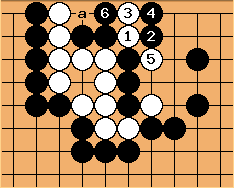
The pair ko rule states that you cannot play at point B immediately after an incursion by your opponent at point A if, on any earlier turn, you played at point B immediately after an incursion by your opponent at point A. An incursion is a play in an empty area only connected to enemy stones.
I came up with this rule a couple of years ago as a more practical alternative to superko. Curious to know what people think about it.
Perhaps you could add detail or a link to the SL page you made for it. For example to back up your claim about bits needed to conform to it, and other assertions. It would also be interesting to hear if you think that it improves the game relative to other ko rules, apart from the question of ease of application.
I appreciate the deep thought you’ve devoted to this proposed ko rule. I’ve read your SL post.
As a newbie to Go, I’d be interested in knowing how frequently a game situation arises where super ko (or alternatively, your pair ko rule) would come into play?
Is this addressing a problem that has been begging for a better solution?
Thanks for any additional context you could share on this.
Interesting idea, I like that you are taking a creative approach to this issue! Initially there is something that feels a little strange about adding the idea of “incursions” to the rules but I can see how it might be worth it to improve gameplay in some of these rare ko situations.
Maybe it would help your exposition on this page to give illustrated examples along the lines of: “here’s how this particular game could have gone differently if the pair ko rule was in use”.
I don’t see how the rule as stated forbids white 7. White 7 is an “incursion” and the rule only governs responses to incursions. (Black 6 is not an incursion as it occurs in a territory not surrounded by stones of the opposite color.)
The rule would forbid a black response at 2 which is occupied, so not possible anyway.
Edit:
I don’t think any of Black’s plays qualify as incursions per the definition.
An incursion is a play by one player in a territory owned by the other player. A territory is a maximal set of connected empty points. You own a territory if all stones connected to it are of your color.
You ask me so I think super ko is a easy rule to formulate and it’s quite convenient online because we keep track easely of the game moves. OTB is another story.
I’ve seen triple ko, quadruple ko and eternal life but I’ve never seen the super ko rule being evoked in an actual professional game. The only game I played that ended up in an eternal life was also judged as a draw/no result.
Let’s say that an n-ko situation occurs if there is a move that would place the board in the same position as n moves before, but not 1,2,…, n-1 moves before. Thus, a 1-ko is ordinary ko, eternal life is 3-ko and triple ko is 5-ko.
What are the values of n such that an n-ko situation has already occurred in a pro game?
For which integers n is it possible to construct a (possibily) artificial n-ko situation?
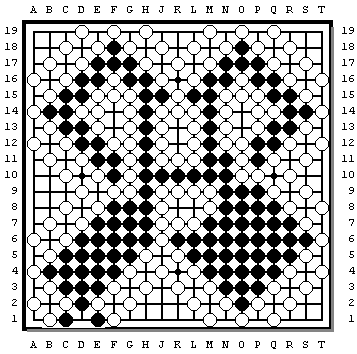
In particular, this position is a cycle of length 100 (a “99-ko” using the above terminology):
Using this kind of construction it is straightforward to make cycles of length 4n for all n > 3. (Although for small n the value of the ko being fought over is also small, so it might be hard to construct a position where playing out the cycle is forced)
Next step: Is there a general construction for cycles of length 4n+2?
For the general construction, I think all we need is that the cycle is forced to determine the life and death of the big black chain. We can give black a big enough territory elsewhere that if black survives, black wins.
I’m not sure if the one above actually fullfills this condition at every possible place where white could choose to fill though! Maybe it does?
But it should be easier to analyze in a simpler shape like this one:
You cannot play at point B immediately after an incursion by your opponent at point A if, on any earlier turn, you played at point B immediately after an incursion by your opponent at point A. Passing is always allowed. Suicide is not allowed.
Am I understanding correctly that in the normal case, when White makes the capture at A (the first incursion),
then Black can immediately recapture (“played at point B immediately after an incursion”), and White can recapture again, but then a second move at B is blocked?
An incursion is a play by one player in a territory owned by the other player. A territory is a maximal set of connected empty points. You own a territory if all stones connected to it are of your color.
Also is this an example of White playing at B immediately after an incursion at A?