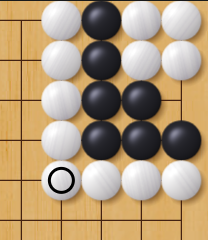
Reminds me of the attack boards in the Star Trek chess variant.
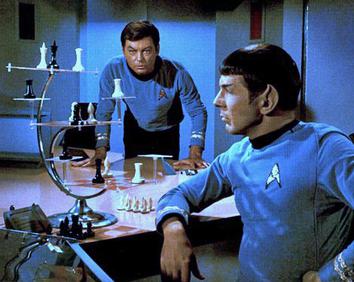
Reminds me of the attack boards in the Star Trek chess variant.
What do you think about “brain chooses N distinct moves, then hand chooses one of them to play.” It would be possible to play this with any other variant (even any other game, really). Could also be a good teaching method.
For teaching it is very great. There are Go problems in this style.
As for a ‘serious’ game, brain could name N-1 obvious bad moves and one good, right?
Not sure what is the best way to implement this mode into Go. x.x
If Brain is Hand’s opponent, Brain can be incentivized to pick equal moves
Though even if they are on the same team, I wonder if it’s still better to pick all good moves. Picking bad moves may help with communication, but there’s still a chance at a blunder.
What about specifying a 4×4 square within which hand has to play? Or specifying the parity (even/odd) of both coordinates (or their remainders on division by some larger number)? In both cases I think the difficulty for hand would vary a lot from move to move.
Maybe the brain decides which kind of move to play — e.g. a hane, push, one-space jump — and the hand decides where.
Defining what is a hane is not easy though. Plus it would be good to have all possible moves be available through some category, like in the chess variant.
Maybe belongs in go memes but here we go…
We all love go here, but we also all know that chess is more popular. Why would this be? Well, chess has evolved a lot over the centuries to be more fun. While go has stayed close to its pure, mathematical original form chess has been adding new quirks to engage the players. Who cares about “playable on an arbitrary graph” and “mathematical theory with well-defined point-values for endgame moves”? We need some new rules!
When pawns gained the ability to move forward two squares, it allowed them to annoyingly sneak past other pawns. Naturally this had to be countered. What tactic is similarly annoying in go?
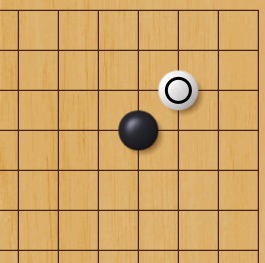
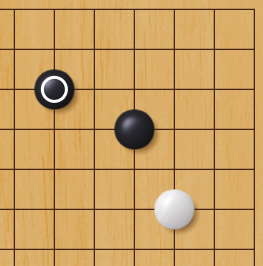
En Passant rule: If you have a stone on 4-4, there are no stones in the surrounding 7x7 box, and your opponent plays 3-3, then on the following move you may make a small-knight’s enclosure and move your opponent’s piece as shown:
→Either direction is allowed. Note that if you do not take this opportunity on your very next move, it is gone forever.
It’s no fun to blunder your king - and it’s no fun for your opponent to win that way either. Naturally, chess disallows this blunder by making it an illegal move to move your king into check. Go needs similar precautions against huge blunders.
Check Rule: Moves that lose more than 20 points according to katago are disallowed, and your client will not allow you to submit them.
In chess, a sufficiently large advantage allows you to force a win in a few moves. This prevents boring games, is more fun for players, and makes absolute time controls more playable. Luckily, ogs has already made some progress on this front.
Checkmate Rule (live on ogs): If you pass three times in a row and are still winning by 10 points and 99% according to katago, you instantly win.
Note that passes that lose more than 20 points are illegal by the check rule, which helps nerf this feature.
Chess has a rule to stop boring games from dragging on forever. Go could do the same thing.
50-move rule: If there are 50 moves without a piece being taken or a piece being played on a star point, the game ends in a draw.
It’s awkward that your king is in the middle of the board and your rooks are on the edges. It would be really annoying if you had to slowly move your king to the corner every game. Naturally chess has a solution: castling! There is a similar situation in go: every four-space eyespace except one is alive or at least unsettled. It’s just too awkward to die in gote with the idiot’s square.
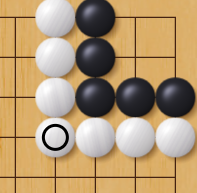
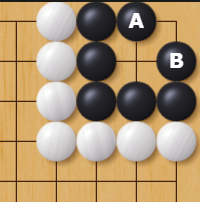
Castling rule: If you have a square-shaped eyespace as shown below, you may play on two of the opposite corners, as shown below:
→Note that you can’t castle through check, so if either “A” nor “B” is a 20-point blunder this move is not allowed.
Chess also places a few limitations on this overpowered move: you can’t castle if either the king or the rook has moved. Thus we introduce the following limitation.
Castling limitation: If there was ever an opponent’s stone at any of the four intersections of the square eye, castling it is impossible.
Thus the following position still has no ko threats for black.
It’s no fun to lose - so chess adds a way to snatch victory from the jaws of defeat and earn a draw in a totally lost position! It also forces the winning player to be extra careful while checkmating. I couldn’t think of a good version of this for go. Tell me your ideas!
Not go variants, but two tsumego variants…
Yeah, you solved it but you didn’t read beyond one move into the future. You’re not achieving the primary goal of increasing reading skill. When you’re in a game, you don’t know in advance whether there’s a solution to be found because it’s not in a tsumego collection. For example, a classic feeble player move which I’ve done often is to defend when I didn’t need to. Tenuki brother.
Okay, that ^^ was not the best example because itself turns into a ko.
Will either idea ever be an actual thing? No, but I like imagining it to be so.
After placing a stone, move one of your stones to an adjacent empty intersection.