why can players restart play after both players have passed?
1 Like
Usually because the players passed too early, and there were still some moves that needed to play before the game can be scored correctly. Like open borders and such.
5 Likes
Stay positive and copy paste a link of the game here. Obviously OGS wants to satisfy the users. So please explain us in a detailed way what happened. If you want some support ofc.
2 Likes
Probably this game: W i d vs. somazome
If so, it’s a bit confusing why the game continued (restarted?) after both players passed. Didn’t notice any change in borders to seal between the first double pass and the final one.
Would appreciate understanding this better too.
1 Like
The fact is that the game is not fully finished in itself although it won’t change the final result. What to do about this is the question
@ SomeGoGuy :
Well, this didn’t change, but A13 + A14 was an open border to seal.
Looks like there was aji in the whites territory at the lower left, so black resumed the game and made a living group inside that corner… Since the game had japanese rules, its been annulled (unfortunately ogs does not have the support for hypothetical play :<)
2 Likes
Yes that is the problem: what we call japanese rules is only an interpretation of it online. I didn’t find a go server with the “hypothetical play” system running online.
Thanks for your careful analysis, I missed the double pass which happened earlier. I agree with you, annulation seems pertinent in the japanese rules point of view.
For the player: if there is no agreement on the territories, it’s correct to resume playing after 2 passes. Black still made a failure to pass because this changes his victory into an annulation so don’t feel too bad on the result😔. And for yourself the white corner was too weak so maybe you should not have left it likewise and add a stone. You made the bet, don’t feel bad on your opponent.
4 Likes
Interesting. Perhaps I’m misinterpreting your comment…
From reading the game chronology, it looked like both players did indeed pass, in succession, on two separate occasions.
By “failure” perhaps do you mean a tactical “mistake”?
I’m still not entirely clear on why this game was annulled.
@ _KoBa :
I’m not sure about the corner invasion, but there’s a more-local problem:
Even if A4 , B4 , C4 , E4 were all white,
the cut at C7 would still capture at least 2 stones.
my two cents worth is the game isn’t over till both parties say its over. or one resigns like i do and give the win to the other guy
2 Likes
Leaving aside the specific game, if someone rejects a correct score twice (i.e., restarts the game twice), then that is defined as stalling, and it is a reportable violation.
What happened after the first double pass was an invasion, converting this
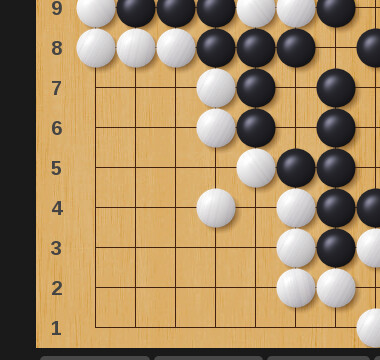
to this
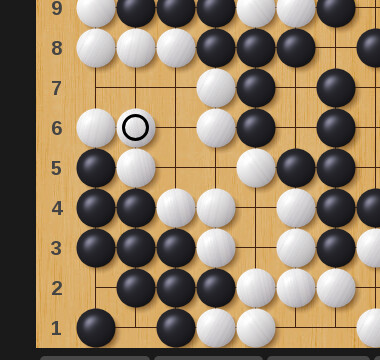
Resumption to resolve a dispute about the live & dead stones seems right to me, but that seems not to be the issue there, and I should like to know how and why the UI let them resume. Since these are beginners, it would be ideal if OGS could help them through such situations with explanations of what is going on, but I fear that may be asking to much from the developers.
I wonder if @W_i_d has anything to say about this (but I suppose they are not active in the forum, as I seem unable to “@” them).
4 Likes
Thank you all. I apologize for getting upset. It was my mistake. Thank you for the help.
4 Likes
Why? To me it looks like this. Black assuming he could live in white territory. And white pretending it’s not possible.
I mean that if black didn’t pass but instead did his invasion he would have won the game. By playing the invasion after the pass it becomes an annulment instead.
You are right. Problem still may occur if there is no agreement on who own what on the board.
In the real life there is a kind of together study (hypothetical play) to fix it, but the end of the game remains as you say, when both passed.
On the internet, it’s simplified in “let’s continue” which is different.
I just add as you know it, that not every game are won by resignation as it seems you are implying it.
So kind of off topic?
That could be interesting to discuss, I invite you to open a new topic as I’m not as affirmative as you are on this.
1 Like
There is a clause in the Japanese rules that if the players discover an unsettled area during scoring such that the result of the game depends on who plays there first, then both players lose. OGS doesn’t support a double loss, so annulment is the closest possible result.
3 Likes
This is true, however under Japanese rules if one player wishes to resume the game the other player has to agree but has the right to play first. Now the rules also say that if a move is found that would alter the result of the game such that neither player can agree to end it, then both players loses.
I could be wrong about this, but I imagine the “both players lose” is to break a deadlock when this situation occurs: one player notices a move that would alter the result if they could play a move, so they do not agree to end the game in favour of their opponent, but they also do not want to resume because their opponent could play first which would defend against the attack. The other player does not want to resume the game to defend, because then their opponent could play first and take advantage of the attack. But this player likewise will not agree to end the game in favour of their opponent. You also can’t resolve it with hypothetical play, because in the hypothetical play, who gets to play first? If black plays first you get a different result to if white plays first.
An issue we have here is the implementation on OGS. If one player wants to resume, they may be able to play first. So, on OGS sometimes the player who wants to resume can play first, and sometimes the player who wants to resume will have to go second. If it is the former case, like in the game discussed in this thread, then you don’t have the kind of deadlock I described.
3 Likes