I’d really like to hear what everyone thinks about AI in the field of Go
2 Likes
Before AI, I (German 5d) did not have regular strong opponents or teachers. Using AI, I have a strong opponent flexible like an unlimited number of different players and an always available teacher.
Professional players’ advice contradicted each other. AI also contradicts itself for flat search. However, if I let it take time for deep search, it plays reasonably consistently.
AI only provides empirical numbers without any reasoning. My own reasoning remains essential. Since I am very good at generalising, I can translate heaps of empirical numbers into reasoning.
Before AI, go was a game taking a lifetime to master. With AI, go remains a game taking a lifetime to master. There is always much more to study and learn. Letting AI do careful search takes very much time.
I could describe, e.g, simplified classes of endgame positions by mathematical theorems and AI cannot ever be better than such truth. For the opening and middle game, AI prevails in playing strength also because mathematical study of go has not advanced far enough for accurate decisions there.
Go is as much fun in the age of AI as it has been before. I can accept that automatons surpass some of my skills and offer me learning input. The effort and joy of my thinking have remained the same.
9 Likes
AI helps a lot to show good moves and good sequences we wouldn’t think about without a teacher, but it made me a bit lazy: I tend to accept the AI’s answer without trying hard to convince myself that other moves would be inferior.
5 Likes
As far as I am concerned I find the idea that “learning Go is obsolete because machines/AI now play better than humans” a bit like a “sore loser excuse”.
There are numerous tools that help humans overcome the barrier of talent and effort that some other humans can have.
For example, someone could have trained all their lives to saw wood fast and with accuracy, yet any geek with a 50 euro powertool would do a better and faster job than them with marginal training. Yet traditional woodworking techniques still exist and there are still a lot of people that enjoy and prefer them to the simplicity of “buzzsaw goes bzzzzzzzzzzrt”. 
In Go, things are even simplier, as far as I am concerned.
First of all a lot of AI is self-trained or it uses already played games that noone really has any issues of copyright, since they are already publically available, so there are not (m)any ethical concerns.
After that:
– AI is a very useful tool for people in higher levels of knowledge and skill, like mr. Jasiek above, or pros, so it is a good thing for them.
– AI is also useful for people that would like to review games but have no access to real life teachers or Go clubs, so it is also a good thing for that kind of job.
– AI is useless for beginners, DDK or high-SDK players, so there is no problem generated there.
and finally:
– AI is only causing problems in the 5k - 2 dan range, where we might think that we have the knowledge to understand the suggested moves, but we probably don’t, which is why I totally avoid using it, unless it is “just there” (e.g. looking at the free level of AI win rate diagram provided post game).
Tl;Dr:
It is a good tool for many cases, not causing problems in a lot of cases and might cause issues in a particular range of players.
4 Likes
Here is a kyu perspective. Like everyone, I was intrigued by the introduction of AI. I had followed the development of chess computers, 50 years ago, and was amazed that AI could plumb the depths of go.
However, I have concluded that AI doesn’t offer much value to kyu players at my rank (7k) and below. That is not to say it is worthless. I still enjoy seeing AI analysis and the rating of individual moves. The problem is that AI doesn’t explain anything, so a player like me has to figure out why an AI move is better. Sometimes I succeed, usually I don’t. Too often a move is better because of the AI’s ability to read widely and deeply. AI variations are often long strings that are far beyond my meager reading ability.
4 Likes
Perhaps I can illustrate with a couple of positions from one of my recent games. White to play:
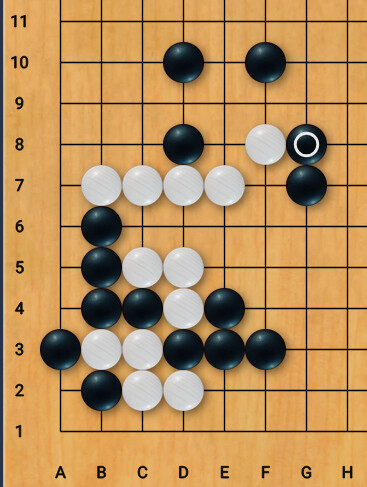
The correct answer is the throw-in A2. The sequence is A2, A1, B1, C1, D1 and White has a ko. Certainly, AI was useful to show me the ko I overlooked. But that kind of sequence is in every tesuji book, so I might have found the ko if I had practiced tesuji in books instead of relying on AI to show it.
The second position is the following. White to play:

In the game I was trying to attack the group Q18. The stone N11 cut that black group from the living group Q8. As my cutting stones N11 were weak, I thought I should defend them with K10. But the correct move according to AI was O13 because it prevents Black from playing atari there, and if Black wants to eat the cutting stones N11 next, then White can attack severely Q18:

It’s easy to believe at this point that I understand move 1 at O13. But when AI shows continuations like this

things become much less clear… It doesn’t mean AI is useless, it does point out that I should try to think about moves like White 1, but it doesn’t train my reading ability that would be necessary to handle the continuation.
8 Likes
I’m not so concerned by AI because I had the chance to play many games with stronger players IRL. And that’s so much better experience, much more emotionally intense. In face to face the worst is to disappoint your opponent.
Now I don’t have them anymore (I moved). I still have players who I teach and chat. And my go lost quite some accuracy anyway.
It’s obviously nice to have a 9d on your phone, ready to give you some suggestions. Even without any explanation. I enjoy it as a regular watcher. I think a game you play with a pro stay much more enjoyable. When I play a bot the feeling turn to something more cold, more about being able to be consistent all the game long. AI pushed the limit of our theories, pushed us to go out of our comfort and try some more extreme. It looks like it’s bringing us to play things too difficult to master and for which we haven’t yet build the background human theory.
Now I don’t like that players integrate the use of it during games. I mean some famous streamers are regularly using it to estimate the position during their game, to check if they are right in their perspective. No one say nothing but honestly considering they are some kind of influencer, I feel bad.
6 Likes
Exploring Go and exploring Human are different goals. There are many ways to explore Human. Chess or Go can be used as a tool to explore Human. When you play Go against AI, you explore Go, you explore AI, but you do not explore Human.
4 Likes
Here is a recent post on reddit asking about an AI-suggested move. Although the discussion is pretty good in general, but I think the one who posted the question really lost the ability to think critically and spent so much time running AIs and trying to justify it, likely for hours if not days, and kinda of fall into the trap of looking for something that is behind their conprehension at their current levels, and learn nothing out of it in the end.
3 Likes
Thanks, @RobertJasiek, I find these excerpts to be essential statements:
4 Likes
I really like your outline of the current situation.
Does anyone know if there are Go AIs with a focus on teaching?
I love AI analysis to check for obvious blunders, to get ideas for what’s most important in certain situations as well as to understand how (or if) I could’ve won a local fight that I lost BUT for many other moves throughout a game the AI moves are just too advanced for my current level to follow.
What would be great, is a teaching AI that plays like 5 ranks above me and gives me good (but not perfect) moves that I can follow throughout the whole game.
Additionally an AI that goes over all my game records and shows me my most common mistakes would be awesome.
1 Like
I’m not aware of the existence of such an AI, so I use AI-sensei, set it at 1d level (which is close to my level) and ask it to show what it considers to be mistakes at that level. Let’s say it finds 15 mistakes, 5 of them are hard to understand so I skip them, 1 is an obvious blunder that I already figured out by myself just after playing it, and 4 of them are repetitions of the same mistake. So 5 positions remain, I click on “remember” and use spaced repetition to review them periodically.
The same types of mistakes come up over and over again, for instance it sometimes tells me to strike at the vital point. The problem is, I don’t know where the vital point is. Perhaps after seeing many board positions shown by AI my brain will become better at spotting vital points. Of course a similar goal could be achieved with a book showing 100 board positions with a vital point to strike, but I’m not aware of such a book.
AI also reminds me basic advice many times, which are variants of “think before you play”. Not sure that having an AI telling that over and over again will force me to think more.
1 Like
Currently, I reckon this is where human Go teachers surpass AI. I recall a well known Canadian streamer/teacher reviewing one of their student’s games - they made a comment like “ah, there’s that move again - we’ve talked about that”. Like, not the exact move obviously but a tendency to throw eggs at walls. Not only can a human teacher recall past games inc. habits, but they can also empathize with human traits like discouragement and burnout. I doubt AI ever competes with that.
That said, I got super excited when I saw the recent Online Go style analysis/tutor tool thread - I had previously imagined such a tool. The idea of AI reviewing a bulk set of say 50 games instead of the traditional review-a-single-game-in-detail is dreamlike. The author said up front it’s still embryonic, see where it goes.
3 Likes
BTW, and please forgive the somewhat off-topic, but I want to mention it for those who don’t know @RobertJasiek: Robert is the author of a lot of Go books:
I have read only a few of them, and, unfortunately, some only partially, due to lots of distractions in my life that didn’t allow me to study Go as much as I’d have wanted, but what I read was always very enlightening, and the Sample Pages Robert offers for every book are, IMHO, very generous.
I especially enjoyed and learned from his book “First Fundamentals”.
Strongly recommended  but check out the sample pages for yourselves.
3 Likes
There was a thread about HJJ Go a while back, but not many people know that they also had a “review tool” that can generate reviews/comments for games played on HJJ Go. Here is an example of review

and when you click view answer, it would show a candidate move and “explanations” of it

And for lower-rank games, it functioned more like simple atari-checker, when a stone or group of stones are about to get captured (not just immediate atari, but also short of liberties, or in ladder/net), and for higher rank games, the “show answer” would often become show Best Variation (sort of differentiate suggestions based on strength)

However, the “explanations” for variations of higher rank games might be very lacking ("like simply stated “stronger/better” based on winrate)
2 Likes