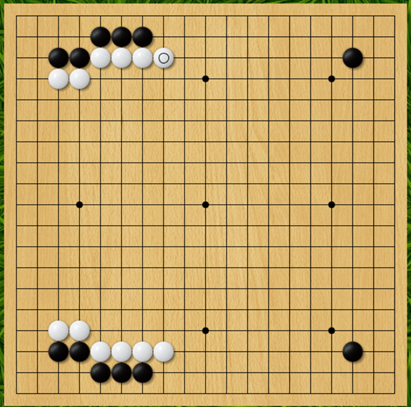
Which side do you prefer?
- Black
- White
- I don’t care
0
voters
For my personal style, “flexible” would be a bit charitable. Perhaps, “aimless”, “futile”, or “ineffective” are more accurate.
Reminds me of the proverbs “If White has all four corners, Black should resign. If Black has all four corners, Black should resign”.
In addition, I see territorial style as setting a perimeter slightly bigger than your opponent’s, and when the inevitable fight begins to keep that fight controlled.
Whereas influence style puts the accent on being able to fight first, then introducing chaotic fights, and trust the process that you end up with profit ant the end.
So maybe the difference (for me of course) is goal-oriented vs process-oriented.
Hum. What is perimeter? If it’s building a moyo, a moyo builder refers more to an influence style as territory.
For me it looks simple. The influence player will reach a point where he has more influence as his opponent and less territories. Charge on him then to reverse this balance by fighting before the game ends…
In understand that in early phases of the game, the territorial player builds territory while the influence player makes walls, which then become moyos which threaten to become territories. The territorial player then needs to invade the moyo so that the influence player can attack and try to profit from the attack by converting part of the moyo into territory, or perhaps even kill the opponent.
Well, sometimes, reducing is enough.
IMHO building moyo is only a part of the use of influence, a wall can be simply oriented to destroy more efficiently the opponent own moyo… What matters is that you like to have that fighting potential more as solid territories.
Yes I should also have mentioned that. Also, making strength while attacking can help to have a good yose because the player with the strongest groups has more sente moves threatening life of the opponent’s groups.
So in short, the territory player wants quick cash, while the influence player invests to get long-term profit.
I think “style of play” refers to some choices you may prefer and one of the most used in comments is here: territory vs influence.
There are still other references. A common one is “honte” often associated with “solid”. Something about slow vs quick in fact. Another one is the “shinogi”. Here something about denying your opponent to occupy the place where he would like to be IMHO.
If you have other suggestions…
I hoped I could get away with introducing a new word without defining it! 
With perimeter I don’t mean a moyo, I mean base or stones intended to become a base.
If anything, a territorial player will prevent a moyo from even forming, leading to a game with many small groups, requiring strong reading. The territorial player prevents the moyo from forming by “pre-emptively” playing a stone or a base (what I called a perimeter) where moyos could occur. Those bases are never sacrificed, but strongly defended to stay alive as small groups.
So a territorial style player isn’t just someone who happened to be more territorial than the other in a game. It is someone who drags both players into a game of small groups and no moyos.
Imho of course.
I think some of the pro-examples on this page align nicely with what I think of Amashi at Sensei's Library
Rank is usually the only metric we have, but it is far from objective in a lot of cases, since we tend to have a lot of topics about how it is calculated, on which time settings it was achieved, where it should begin (e.g. the usual topics about new players getting too high early ranking), what its range should be and what are the corresponding ranks across servers or areas.
Assuming that one would be willing to put things to the test in a similar way like I described for basketball where there are various objectives and metrics (defensive ability, rebounding, horizontal speed, lateral speed, reaction time, ball handling, vision, passing ability, propensity for turnovers, jump height, jump timing, field goal percentage from four different zones - under the basket, close range, mid range, three pointer and so forth… some of them are easily quantifiable, others are a bit more abstract and harder to measure, but they do exist as categories) similarly there could be objective tests where players could get measured and compared, if such tests could be compiled, in areas like opening, joseki, tesuji, endgame, life and death, direction of play, attacking, defending, reducing, sabaki and so forth.
As long as it is within the same server and it compares players that usually compete with the same time settings and they have played a sufficient amount of ranked games (let’s say 100+) so that the ranking algorithm can have a big enough dataset for them, then I’d agree that it is as objective as it gets. 
I’d rather play black here, but it’s way more likely that I would actually be white. Then I would be annoyed, would remember myself about the proverb and would probably end up killing something in the center.
This position is derived from a game I played and lost as white. AI says that White is leading by 20 points but I didn’t feel ahead and tried something too risky in the center. AI says that White should let Black make a big territory in the center, reduce it a bit, and make points on the sides.
I was expecting a multiple choice vote so don’t elaborate on my choice (no way to cancel)
" < vote " , and then “undo vote”
I would have significantly more fun if my side game was bolstered. Corners I typically concede/sacrifice since I play the 3-5 point opening anyway. Being high dan in the center, i.e. building moyos and using influence is another attractive option, that would be my choice if I played tengen openings or had stronger life-death problem-solving. But most of my games I lose because I die or fail to kill on the sides due to my lack of tsumego experience, so I picked sides.
All are difficult, but corners are easier to study because there is a lot of material on corner tsumegos and on josekis. But it’s not really possible to separate corners, sides and center. The outcome of a joseki affects the sides and the center. Conversely, a strong center may affect the success of a corner or a side invasion, etc.
Thx
it’s a philosophical question so i also assume it’s hypothetical on the basis that it’s possible to separate strength in the 3 categories. Of course all 3 categories have overlap but corner problems would mostly be life and death and joseki, center would be about moyo and influence, and sides would be influence josekis, a bit of life and death, but unique to side problems IMO is direction. That’s also very important – choosing the wrong side to develop or the wrong distance to make an extension on the side can easily cause overconcentration issues and weaknesses. I’ve lost a lot of games due to simply choosing the wrong direction to extend in (i.e. bottom vs left, or left vs right), not life or death.