OGS has design issues

As much as I love OGS and it’s cause:

The site is severely lacking in terms of its design. Depending on its goal.

While it’s easy to get blind when you are used to something, the site is by no means intuitive. After having had a longer break that became extremely clear, and I far better understand why my friend get turned off by the site, when trying to get them to play independently.

Without going of the rails, a few things stand out

  • To many options for creating and finding games, which makes each option have less players. There should be much better ways to section it and show how many players are available.
  • There should be curation for problems, with some sort of gamified system for progress.
  • The UI is functional, but by no means eye catching and fun. It also lacks coherent structure for anyone who isn’t used to it. While it is nice for many of those who use this forum, it is objectively not good for casual players and beginners.
  • Beginners get thrown into the gutter when starting. The beginner grade should be lower, or perhaps even use AI to get an estimate.
  • Better curation for bots to keep players satisfied, even when few others are online.

But that is only the tip of the iceberg. The site is great for an active tight knitted community, but it is absolutely terrible for beginners and casual players.

The poster child should be chess.com

One may say whatever they want about chess.com as an organisation, but in terms of design and accessibility it is leagues above OGS. I say this as someone who does not like chess particularly, and have worked diligently to get friends into GO. I have yet to meet anyone who navigates OGS with ease. The site is built on community contributions, but at some point there needs to be clear curation. At least of the most visible layer for the site. And then a way to access community options that is easy to reach, but does not clutter the curated part of the site.

If using general game design principles, OGS is more like a Handbook and free for all than it is an experience. This might sound wifty wafty, and a comment will never make the arguments justice as it’s to complex an issue. But I strongly believe OGS need a huge overhaul if the goal is to be the main site for the west, long term.

The dev team does a GREAT job technically, but I have a feeling there isn’t anyone with a schooling or at least proper understanding of design principles and human UI interactions.

5 Likes

You’re a little late to the party. I think they know by now. I’m sure they will look into the recent UI/UX feedback when they find the time.

3 Likes

You’ve made some great points, and thanks for posting this.

You’ll have to give me specifics, this is too vague. I get the general idea of what you’re saying but I will need some specific direction for research.

[DISCLAIMER] I am not a core dev team member. Just some dude.

And as @Regenwasser mentioned, I am sure core members have taken a note of the design discussions.

1 Like

I’ve given up on it. I notice a lot of very skilled engineers, people with PhDs, etc. are completely color-blind to what good design looks like (and what good music sounds like, but that’s a separate matter). They’ll lean on data because it’s all they have, and they’ll ask you to translate everything you see and feel into a meticulous, technical language – and it can burn you out if you’re not careful.

It’s not only talent in the arts departments that is missing from the core dev team, it’s also understanding of the game of Go and how to teach it.

  • As an example, on the Puzzles page lists mark5000’s “Exercises for beginners” as the top-rated collection. The 2nd puzzle in it is a 15 kyu problem that would alienate half of beginners.
  • Everyone will recommend beginners to start learning on 9x9 even though it’s like telling a kid to only practice football/soccer 1-on-1 until they’re good enough to play as a team.

…and there are 100s of issues like this throughout the Learn to Play Go page, other puzzle collections, and the rest of the site in subtle ways.

It’s odd, but there seems to be roughly inverse relationships between Go skill and communication skills, engineering skill and artistic talent… and an overwhelming majority of the regulars and people with the biggest voice in these forums are engineers with great communication skills, so polls and discussions which end up influencing UX decisions are heavily biased. Expecting them to make the premier Go platform in the world is like expecting them to make the best video game in the world with only great engineering, ASCII art, and surface-level understanding of game design and game theory.

I’m not an engineer – I’m an artist at heart. How many times have you thought “something’s not right but I can’t put my finger on what it is”? That’s called intuition and it’s what separates art from engineering in a lot of cases. These engineers replace intuition (or lack thereof) with data. So I’ve decided to focus on improving my own coding skills enough to make my own Go server in 1 or 2 years at this rate – that would be faster than trying to make OGS something it never was. OGS was originally a correspondence server like dragongoserver.net

But I won’t stop you from contributing, @BilGoBaggins – if you can communicate all of OGS’ flaws in a way I couldn’t, you deserve an award. I made them aware of some of the issues, but I only scratched the surface before getting frustrated and burning out.

4 Likes

Is it really? :thinking: I tried to use it recently and I found it way worse than OGS, to be honest…
That’s actually not true… I’ve been here for a few years and almost everyone seems to have their own “ideal point of entry” for teaching the game.

Polls in the forum about the design of the website are a bit pointless in terms of expressing what the OGS playerbase might want, since the forum is used by a very tiny fraction of the OGS playerbase.

So… Dwarf Fortress?

3 Likes

If I explain in great detail in this comment I would likely burn out my fingers, and waste time.

But imagine it like this: your read a book about history. This book could be created in many different ways

At one extreme end you have a wall of text without indentations. All the information is as compact as can be, and the language might even by dry to keep it efficient.

Then another version might included pictures.

Then you have one with titles, subsections, pictures and colour. It might included fun but somewhat irrelevant trivia, with colorful language and a layout which is easy to follow and find the relevant information in. It used narratives and emotion to catch you interest, and is paced in a way that gives a constant feeling wanting to turn the other page.

A very common theme with technically talented people is that they create something efficient and slap on some UI to make it look nicer. Every feature is included with equal emphasis, because clearly people will find what they need when they look for it. But they do not understand what good design is or feels like. How to guide the eye, where to create emphasis and contrast, how to limit options properly to not overload visually. Because they are themselves not the general population.

The same neuro-type that made them good at (or deeply enjoy) programming and working through libraries of code and notation, where things is systematic and “efficient”, creates a huge blind spot for what good design is to others. For them good design is somewhat equivalent in “vibe” to bad or half decent design for others. Perhaps it might even feel unnecessary.

I am strawmanning of course, and I place no judgement with this, but I would guess this is the case. Same as I’ve noticed with many peers in my math and engineering courses. It’s a great asset, but because design is abstract it is greatly underestimated how important and difficult it is to get right. It’s clear when it there, but unless you have the interest or knack for it it difficult to create from thin air.

OGS suffers greatly from this. And it’s clear they might need an outsider with this skill to guide them, and then simply listen and be open to that individuals opinion. Because they themselves will likely struggle to understand it at an intuitive level.

3 Likes

In regards to you comment on chess.com

It is by no means perfect. But from a general point of view - yes, it is better.

It is slightly cluttered, but when it comes to how it presents things visually it is much clearer. The page navigation is far from great, but they have a clear curation of content that makes it much easier for users.

Take for example problems. On OGS you get user created content, and it has no clear check marks, no progress markers, and no logical progression. You might disagree with that, but then you are the outlier. That is not meant as a mean comment, although I understand if it comes through as such. It’s just simply the case.

In general

People thrive on clear progress.

People thrive on less options (with the option to tweak more if necessary)

People thrive on strong visual design.

People thrive on narrative (ex Bots with personalites and play styles, level up systems through different stages and visual cues)

There’s much more. But if this doesn’t matter much to you, you are the outlier statistically. That is not a bad thing, but it is not what carers to wider audiences. And I woul like to believe that could be done without sacrificing what makes OGS nice for people in these forums. But people on these forums are not the norm.

1 Like

Yes, it doesn’t have that because it’s just a collection of user created content, not a coherent learning process designed from the top. Because that would take significant time to design.

There’s several hundreds of employees behind Chess.com, while OGS is one guy and a bunch of nice volunteers; resources are very limited. Feedback is nice and welcomed, but one needs to keep in mind there will always be an easy answer as to why OGS is not as polished as chess.com.

4 Likes

yeah, chess.com isn’t the best example. it has some good parts like the interactive tutorial, but ive said many times it’s pretty badly designed too. lichess is better. People simply can’t imagine how a company with hundreds of $millions wouldn’t have hired the best designers to work on their UI – they think company revenue directly translates to being world-class in every category, like some sort of halo effect I guess?

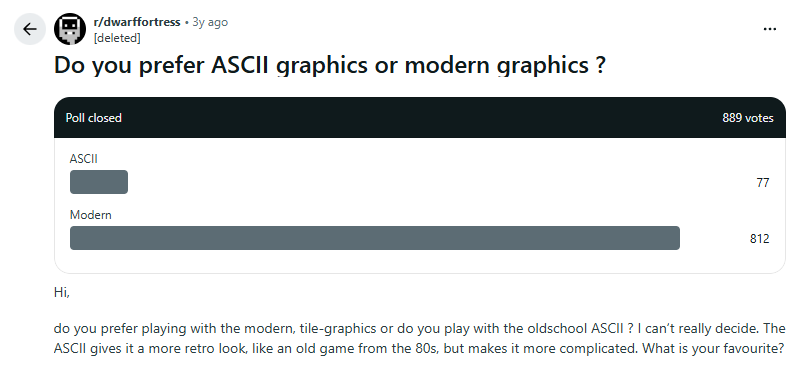
nice, i didn’t know about Dwarf Fortress. Seems like it had addicting and deep gameplay even with only ASCII art:

but it’s worth noting that most of its players today prefer a modern pixel style to the ASCII style:

Well-said.

I believe it simply comes down to the fact that there isn’t enough of a market in Western Go for anoek to hire a world-class designer right away. Additionally, you can’t just hire anyone – either the designer needs to be very good at Go himself/herself, or he/she needs to be in close communication with a professional Go player AND professional Go teacher (playing and teaching are very different skills) to make sure the entire UX flow feels right for beginners.

I would hazard a guess that anoek plans to push a bit further with his current dev plans and see if he can make OGS go viral like chess.com did first, then hire someone when he’s confident he will be able to get a return on his investment. Because his ability to put food on the table and retirement plans depend on these kinds of decisions. I wish him the best for his health and family; our aspirations for OGS are not as important.

2 Likes

I do not claim it reasonable for OGS to have everything as polished as chess.com

But some amount of curation should not be that difficult to include. If OGS has a talented and somewhat pedagogical group of volunteers.

AI bots are easy, by simply using existing ones and renaming them, and having a clear section for playing against them.

Curation of problems should be somewhat easy. If there are dedicated people on OGS trying to make GO popular, that already spend a lot of time in related ways, this should be a low hanging fruit.

And curated lists can change over time of course. But the basic feature shouldn’t be to difficult to implement.

I have full understanding it is still time to allocate, especially for 1-2 people. But in theory it should be a worthwhile persuit. I also want to make clear I am not judgemental of how OGS is run, but I do see a huge, huge amount of untapped potential that is relatively easy to obtain (unless there would need to be some truly unpleasant coding and work arounds. But cosmetics shouldn’t be too bad), given a better framework from someone who understands human-computer interaction.

I also feel that it would be important to do this in a somewhat near future, as I see no reason that a small dedicated team couldn’t provide a service that includes all these features and design concepts, with relative ease. Then they would simply swoop in from below and steal the show.

Will it happen? Probably not.

Could it happen? Very, very much yes.

There is no technical hurdle; only time and some collection of 3-5 individuals with cooperation and differing skill sets of somewhat high level.

I’m curious if there ARE puzzle collections on OGS currently that would meet your criteria for well-designed puzzlesets for beginners. If you’re complaining about the most popular puzzlesets on the site, I am unsure if what you are suggesting is ultimately a curation problem vs a content creation problem. And of course writing or licensing new tsumego sets is much more involved and/or more expensive than just curating existing collections.

  • Beginners get thrown into the gutter when starting. The beginner grade should be lower, or perhaps even use AI to get an estimate.

I also want to push back against this. The problem with matchmaking as a beginner is the matchmaking pool is not large enough. Messing around with beginner MMR placement doesn’t really matter if anyone 24k and above is inevitably going to be thrown in the same pool anyway. And solving the combination of the popularity of Go in the west and the playerbase being distributed across different sites is a… much more nuanced and complex issue than a technical skill estimation problem.

2 Likes

Very valid point about the grading for beginners. I have no refutations for that.

And about possible beginner sets: it’s not at all impossible there exist one. But there should then be some “official" set that is used.

What I mainly feel my complains, or rather remarks and wishes, would be for the site to have engaging and fun design. This is very much a subjective taste, but from general design perspective the site is not good for casual players. Wether or not the contents exists in the site is by no means the same as presenting said content in a good way.

What matters is the presentation. Because that is how you get users on a larger scale. I don’t think that can be argued against, and I believe it’s the first and most important hurdle for the site. Any other effort will have diminishing returns as a result.

An analogy: Ingredients matter. How you combine them matters a lot more, and you can have to many in a single dish. Finally, how you present them on your plate is very important to get people to even consider tasting it, however delicious.

My point about the puzzle collections is to try to take your abstract suggestions of “things should be better” and ground them in practical suggestions that could be implemented today.

“There should be better curated puzzle collections” okay! I can agree with this! So what collections currently exist that are worth curating? Who is going to curate them? Are you willing to help sift through the current collections? If they don’t currently exist, who is going to create them? If no volunteer is willing to write an ‘official’ set, where is that budget coming from to pay someone to write a set or license an existing set?

And I ask all of those questions not to imply “this is an insurmountable amount of work” (it’s not!), and more that… you’re not a paying customer of a product built by a VC-funded corporation, you’re a member of a community built around an OSS project. This is not chess.com, because it’s Lichess, even if you’d prefer it be chess.com. If something sucks, GitHub and the puzzle collection editor are both right there, you can pull up your sleeves and make it better.

It’s very easy to complain about OGS. We are all well aware of its shortcomings, and have varying levels of empathy and understanding for what it means to build a community-driven OSS project with limited resources. Heck, I built my own iOS OGS client to solve many of the things I personally found frustrating. I just don’t think “I wish the site would be better” is either concretely helpful or particularly motivating, since (as @Regenwasser pointed out) a lot of your complaints are not particularly new.

To use your own cooking analogy: if you went into the kitchen of a restaurant in your neighborhood as a customer and told the head chef “your food just isn’t good, you really need to focus on presentation and taste!”, would you expect a productive conversation to come of that?

1 Like

I happen to have an acquianted top-tier UX designer (a good friend of a good friend ). He has designed the complete UX (not just UI) for a couple of the absolute largest Dutch companies and government agencies,

I have zero doubt that he could analyse the needs here and design something that works. He’d probably interview you and others to figure out what a Dan player cares about, but he doesn’t have to be one. It’s much more important to understand how to the process works to get to a good UX, because UX design is it’s own process, unrelated to being good at go. Teaching is a subset of the UX, not the main thing either.

IMO, the main problems of OGS UX are simple to summarise:

  1. Visitors want to orient if OGS is a good choice for them.
    It needs to tell them:
  • what is Go exactly?
  • you can learn how to play here,
  • you have the opportunity to play, quick games, tournaments, ladders.
  • there is a fun community here, with a forum, chat, options to contribute.

However the main visual thing presented to them is a grid all the games currently played. This tells them “games are being played here”, but not the other things.

  1. New users need guidance on where to start
  • Where do we start games?
  • Where do we learn to play?
  • Where is the social stuff at?

This is the part where Shamisen focused on, as he rightly pointed out that his screen was mostly empty, especially in the center where the focus is. Ironically Shamisen isn’t a new user or a beginner at all but I’ll get to that.

  1. Established users need focus/triage/priotisation on what needs their attention
  • Established users use any one of the 10-ish main functions that OGS offers:
  • For live players: where is action the hottest, are dan+ players online so I can finally get a game?
  • Which tournament / rengo game is about to start soon?
  • What is the Go (global) news?
  • Who sent me chat messages, who replied to me on the forum?
  • Which correspondence game needs a move now?
  • For (community) moderators: is there an urgent task?
  • For bot operators: are my bots still online?

This is what OGS UX does reasonably well. It can definitely be improved upon for players who don’t have multiple things going on, because they get the same experience as the new users. But it’s not annoying to use once you figure out where things are.

So imo when we talk about UX needing improvement, the improvements need to answer these questions, without creating new questions. (It’s not a complete list of course).

As far as priority goes I think:

  1. highest priority is New User UX, to avoid users getting lost
  2. followed by Visitor UX, to avoid them passing on OGS
  3. followed by Established User UX, to increase enjoyment

ps. I say this because I want to move the discussion constructively back to what needs improvement.

5 Likes

Response from a member of “the dev team” …

Thanks for your thoughtful, constructive input.

It’s really appreciated.

We know.

We really know - it’s been discussed many times, as others have linked to.

We say to each other often “hmm, I dunno, I’m not a designer” :sweat_smile:

The problem is not a lack of awareness of the issue.

It’s not a lack of a list - like those above - of things that need to be fixed.

There is no new news in the preceding thread, as far as presentation of “what the problems are” is concerned.

There is not even any new news in the discussions of “what would be done to fix it”

Here is what the root cause of the problem is, as I see/experience it.

  1. There is not a UI designer “on the team”, and OGS isn’t a “company that can hire one”

Other than the owner, all contributors are basically volunteers, and they are almost exclusively coders.

Which leads to:

  1. Getting started as a volunteer “UI design-contributor” is orders of magnitude harder than getting started as a coder-contributor.

Code-contribution is very easy for someone who is familiar with the tech stack and contribution processes. You have an idea, code it up, put it out there for eveyone one to see and consider, then submit a PR … fix and boom it’s in.

UI contributions are nothing like this.

In a “software business” UI design is a process, embedded in a bigger process of “how the product is designed and implemented”.

We have none of that in OGS, because OGS is not big enough to run in that way.

So what does a person who is a UI Designer and has ideas about how to “improve OGS” have to do?

They have to commit to making a difference and find out how to inject their knowledge so that it takes effect.

This will be a people, relationship and process challenge far more than a UI tools and ideas challenge.

Posting here in the forums is almost a complete waste of time especially as the first action.

I say “almost” because it is actually not a waste of time to establish design credentials and community support. Saying “hey, I am a UI designer and I’d really love to help fix something specific … I have these ideas, what do you all think?” is good.

BUT doing so with the expectation that “it will flow from there without effort” is a waste of time.

The first thing that needs to happen for a UI Designer to make a contribution is it find out from anoek how to work together on UI Design"!

It is “scope out the landscape and see how things work around here” then find a way to make a difference.

And this will take a small concrete idea to run with and try - a big bang grand vision change all at once will flop. (Anyone who knows about implementing change knows this is obvious)

We have had precisely one person tackle this that I’m aware of - someone who actually engaged with the dev team rather than complained about the UI in the forum.

I think that any UI designer who really wants to contribute to improving OGS should chat to that person first, to find out what their approach was and what obstacles need overcoming, as a first step. I can put you in touch with them, or they may speak up here.

The second step is to engage with anoek. Nothing else will work.

And before all of this comes the decision to actually contribute.

Posting here is nice, but it’s not helping - we get posts like this every few months or so.

If you think “if only they knew what I know they’d fix it, so I will post here and things will get better” you are wrong about that.

For the UI Design of OGS to get significantly better, it needs a hands-on champion who pushes through the execution of a vision. Not suggestions thrown out there, however well meaning and well thought through… and left to sit.

13 Likes

I think I did the exact opposite; I said something like “hey guys, I have zero UI design experience but I can do a better job than all of you combined, so here goes!”

1 Like

You missed this bit:

At least from where I’m sitting your approach was “I know what I’m suggesting is better, so I will just do it and surely they will adopt it”.

And you moved from there to “Wow, doing my vision on their current platform is hard, their current platform sucks, I better tell them how sucky it is, that will surely help” :wink:

3 Likes

Actually it wasn’t clear to me that the dev team was fully aware of the design flaws, because from the very first thread Regenwasser linked, there was so much push-back on someone critcizing the site’s user experience for beginners/newcomers:

And these voices are voice that anoek has reason to trust (though I don’t know to what extent he actually agrees with them) due to their other contributions. It’s just that when it comes to design-related criticisms, the critics’ opinions get dismissed with disdain. There’s nothing wrong with being color-blind to design but when the color-blind have such a strong opinion on color, so to speak, you get the blind leading the blind.

1 Like

I’m genuinely sorry that you experienced disdain for your new ideas.

From a different view point, the things you experienced as disdain were just actually the “right questions being asked”.

We (collectively, and uncoordinated as we are in our community response) probably missed the first step of welcoming your new ideas before challenging them in the necessary ways.

I hope I fixed that bad reaction in this thread, so that the OP both understands that new ideas are welcome BUT fixing the UI design might be a different challenge then they thought.

I personally am longing for a UI designer to work with - someone who’s there to see it through, and can figure out how to make UI design work for and with us.

2 Likes

I unfortunately have to keep.the response short due to time of day and keeping some half decent sleep schedule.

I actually planned to take contact directly, but I couldn’t find who/how to contact. I didn’t spend too much time, but enough time for it to be clear the information is not handed to you with enough ease. I would have had no idea you were even looking for and UI designer. And if it’s written in some of forum post that is not enough. People won’t go searching to find that type of information.

I am personally not a UI/UX designer by trade (studied mathematics, and have worked a lot with and studied design in regards to other hobby projects), so I may lack the practical skills even if I posses the theoretical framework and general sense of what should be done and how it should look. I would love to help out in some way of possible, although I may not be of as much help as I (or you) would like. Would be open to having the conversation however, although I am sure you need something else. Would love to help find someone suitable if nothing else.

From what you’ve said however; I do strongly, strongly suggest that you perhaps put out some official statement about looking for UI/UX designer. I believe there has to be someone, that simply has no idea that it’s even an option to be part of the project. It’s easy to assume the forum and reaching out to you guys is obvious, but it is not. And this is a similar issue as mentioned earlier about design and presentation of information. Sure, if someone really really wants to they will. But most people just sorta want to, and given the opportunity they would be glad. And unless they are received with open arms, they will lose interest quickly.

Even the responses in this thread made me feel quite negative about this whole experience. Wether the intention or not, it does not feel like an open invitation. It sounds more like “prove yourself worthy, then you can join”. Which might not be the point, but even someone who is willing will find the responses here quite discouraging.

If you reach out a hand, and make it clear as day you need help and are willing to listen, then someone competent is likely to grab it. Expecting things to go the other way around (especially if you already know you need a designer) is quite optimistic. I made this post in some well meaning frustration, but most people with the necessary (practical) skills will simply move along and not think about it to deeply, even if they could be interested.

All love to devs and you skills, but you ability to market your needs is not at all up-to-date. Which I suppose is and extension of the issue at hand.

3 Likes